A Maryland arrest records search can lead to several different types of records, depending on what you need to find. A court case search may show charges and case outcomes, while a local police or sheriff’s office may hold an arrest report or booking information. A statewide criminal history check is a separate process handled through Maryland’s Criminal Justice Information System (CJIS).
This distinction matters because an arrest is not the same as a conviction. Someone may have been arrested but never charged, or a criminal charge may later be dismissed, result in an acquittal, or be otherwise resolved without a conviction.
For most public searches, the Maryland Judiciary Case Search is a useful starting point for locating criminal court cases. For a person’s official Maryland criminal history, however, the state’s fingerprint-supported CJIS system is the appropriate source.
What Are Maryland Arrest Records?
An arrest record is information created when law enforcement takes a person into custody or documents an arrest-related event. The exact information available depends on the agency, the type of record, and whether the matter proceeded into the court system.
An arrest-related record may be connected with:
- The person’s name
- Arrest or booking information
- The date and location of an incident
- The arresting law-enforcement agency
- Alleged offenses or charges
- A court case number
- Court dates
- Case disposition
- Related police or incident reports
Not every item will appear in an online search. Different government agencies maintain different records, and some information is restricted by law.
Most importantly, an arrest does not establish guilt. A person is not convicted merely because an arrest occurred.
Are Arrest Records Public in Maryland?
Maryland’s Public Information Act gives the public broad access to government records, but that does not mean every arrest-related document is automatically available without restriction.
The Maryland Attorney General explains that anyone may submit a Public Information Act request for government records, but agencies may withhold records or information protected by law, privacy requirements, or applicable exemptions.
Public access depends on the record
The availability of information can depend on whether you are seeking:
- A public court case record
- A police incident report
- A booking or jail record
- A statewide criminal-history record
- A juvenile record
- A sealed, shielded, or expunged record
- Information connected with an active investigation
The agency that created or maintains the record is usually the place to request it.
Criminal history is different
Maryland’s CJIS Central Repository maintains fingerprint-supported criminal identification records and criminal history record information. That information is not simply an open public database. Maryland law places restrictions on its dissemination, and CJIS states that criminal-history information is kept secure and is not available to the public without proper authorization.
This is one reason a general internet search or a Case Search query should not be treated as an official statewide background check.
How to Search Maryland Arrest Records Online
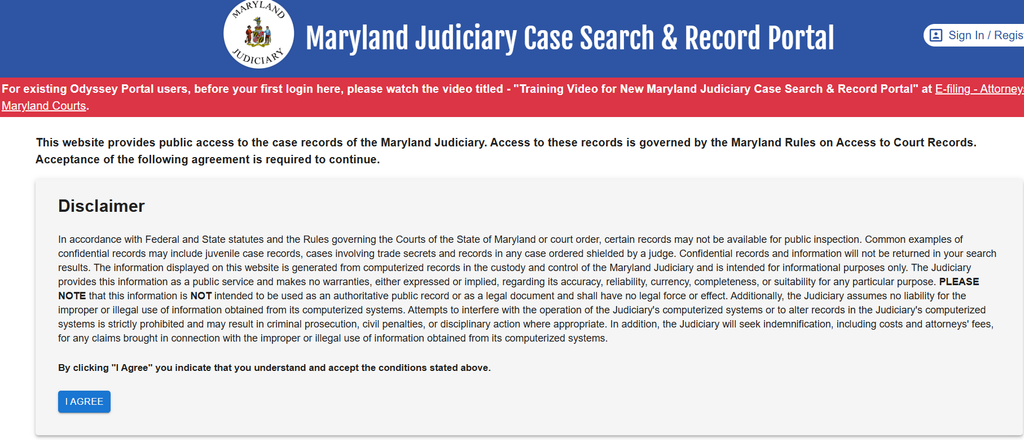
For many searches, the easiest starting point is the Maryland Judiciary Case Search.
Case Search provides public access to information from Maryland District Court and Circuit Court case records. The system can provide information such as party names, case numbers, charges, dates, and dispositions, although it is a summary rather than the complete court file.
Step 1: Open Maryland Judiciary Case Search
Use the official Maryland Judiciary Case Search website rather than relying on a third-party database.
The current system requires users to accept the applicable access terms, and CAPTCHA technology may be used before searching.
Step 2: Search by name
Enter the person’s name as accurately as possible.
Maryland Case Search defaults to exact-name searching. If you need a partial-name search, Maryland Courts explains that you can use a percent sign after at least the first character of the last name. The wildcard cannot be placed at the beginning or middle of a word.
A spelling difference can therefore affect your results.
Step 3: Narrow the results
If the name produces too many results, use additional information where available.
Useful details may include:
- First and last name
- County or court
- Case type
- Filing date range
- Case number
- Other identifying information displayed by the system
The Judiciary notes that Case Search can return up to 600 records for an overly broad search, so narrowing the search may be necessary.
Step 4: Review the case information
Once you find a potentially relevant case, check the available information carefully.
Look for the:
- Charge
- Filing date
- Case number
- Court
- Case status
- Disposition
- Scheduled or completed proceedings
Do not assume that the existence of a criminal case means the person was convicted.
What Can You Find Through Case Search?
Maryland Case Search covers a significant amount of publicly accessible court information. The FAQ states that it includes Maryland District Court criminal cases and Maryland Circuit Court criminal cases, along with various civil, traffic, and appellate records. Historical availability can vary by jurisdiction.
However, Case Search is not a complete arrest-record database.
Court information is not the same as a police file
An online case result may tell you that criminal charges were filed and provide information about the court proceedings. It does not necessarily provide the complete police report, investigative file, booking record, photographs, or every document associated with the arrest.
Maryland Courts explains that Case Search provides selected information from case records, while complete judicial records are generally maintained by the appropriate Clerk’s Office.
Some records may not appear
Certain records are confidential or restricted from public access. Maryland Courts identifies examples including juvenile delinquency matters and records that have been expunged, shielded, or sealed.
The absence of a result therefore does not always prove that an arrest never occurred.
How to Request an Arrest or Police Record
If you need an actual police record rather than a court case summary, identify the agency that handled the incident.
That may be a:
- Municipal police department
- County police department
- Sheriff’s office
- Maryland State Police
Request the record from the agency
Maryland’s Public Information Act allows people to request disclosable government records. There is no single central office that handles every PIA request. The Maryland Attorney General recommends contacting the agency that has custody of the record.
When making a request, provide enough information for the agency to identify the record.
Useful details can include:
- Full name of the person involved
- Approximate arrest or incident date
- Location of the incident
- Report or case number, if known
- Arresting agency, if known
- A specific description of the record requested
A precise request can make it easier for the agency to locate the appropriate document.
Maryland State Police records
For incidents handled by the Maryland State Police, the agency provides a process for requesting certain police reports from its Central Records Division.
For an official Maryland State Police incident report, the agency asks requesters to provide information such as the report number, incident date and location, and names of victims or suspects. Some records may be subject to fees or legal restrictions.
Maryland Criminal History Checks
A Maryland arrest search and a criminal background check are not interchangeable.
For an official Maryland criminal-history check, the relevant state system is the Criminal Justice Information System, or CJIS, operated by the Maryland Department of Public Safety and Correctional Services.
CJIS maintains Maryland’s fingerprint-supported criminal identification and criminal-history records. The system is used by authorized criminal-justice and non-criminal-justice entities for purposes allowed by law.
Can you run a CJIS background check on someone?
Not simply because you want to know their history.
CJIS states that criminal-history information is not public without proper authorization. Employers and licensing agencies may obtain certain checks when authorized under Maryland law, while individuals can request certain checks concerning themselves.
This is an important difference between searching public court information and obtaining protected criminal-history information.
Checking your own record
Maryland residents can request an individual background check through the CJIS process. Fingerprinting is part of the process for the applicable criminal-history checks.
CJIS also provides options for individuals who live outside Maryland and need to request an individual check.
Arrest Records vs. Criminal Records
These terms are often used interchangeably online, but they describe different things.
| Record Type | What It Can Show | Main Source |
|---|---|---|
| Arrest record | Arrest-related information | Arresting law-enforcement agency |
| Court record | Charges, proceedings and disposition | Maryland Judiciary |
| Criminal history | Fingerprint-supported statewide history | CJIS |
| Jail or inmate record | Custody information | Appropriate correctional agency |
| Police report | Details documented by law enforcement | Arresting or investigating agency |
The correct source depends on the question you are trying to answer.
For example, if you want to know whether a criminal case was filed after an arrest, Case Search may be useful. If you need the person’s official Maryland criminal-history record, CJIS is more appropriate.
What If Someone Was Arrested but Not Charged?
An arrest does not always result in a criminal court case.
Maryland’s CJIS materials distinguish between an arrest and a later release without charges. Maryland law requires reportable arrest information to be reported to the Central Repository, while information concerning a person released after an arrest without charges is subject to a separate reporting requirement.
There is also an important record-clearing rule for certain police records.
Maryland Courts states that when a person was detained by a police agency but released without being charged, the police records relating to that detention are automatically expunged within 60 days after release under the applicable Maryland law.
That means a later search may not show information that once existed.
Why an Arrest May Not Appear in Search Results
A missing result can have several explanations.
The arrest did not lead to a court case
If a person was released without charges, there may be no criminal case to find through Case Search.
The name was entered incorrectly
Case Search’s exact-name default can make small spelling differences important. Try the correct legal name and, when appropriate, the partial-name wildcard method described by Maryland Courts.
The record is restricted
Juvenile, sealed, shielded, and expunged records may not be publicly available.
The record is not maintained by the court
A police report or local booking record may exist with a law-enforcement or correctional agency rather than the court.
The case information is no longer publicly displayed
Maryland has made changes to the availability of certain criminal case information on Case Search. For example, Maryland Courts currently notes legislative changes affecting certain stet charges and cannabis-related cases.
Expunged and Shielded Arrest Records
Maryland provides different legal procedures for limiting public access to certain records.
Expungement
Expungement removes qualifying information from public inspection and can involve court and law-enforcement records. Eligibility depends on the circumstances and disposition of the case.
Maryland Courts provides separate forms and procedures for different types of criminal dispositions. Some eligible filings have no fee, while certain eligible guilty dispositions have a $30 filing fee.
Shielding
Shielding is different from expungement.
When a criminal record is shielded, it is removed from public view, including Case Search, but certain law-enforcement agencies and other authorized entities may still be able to access it. Maryland Courts describes specific eligibility requirements and waiting periods for criminal-record shielding.
For this reason, finding no public Case Search result does not necessarily mean that no record ever existed.
How to Search More Accurately
A good search starts with reliable identifying information.
Gather the person’s details
Before searching, try to have:
- Full legal name
- Approximate age or date of birth
- County where the arrest occurred
- Approximate arrest date
- Possible arresting agency
- Case number, if available
Search the court record separately
Use Maryland Judiciary Case Search to look for criminal cases connected with the person’s name.
Contact the law-enforcement agency
If you need the actual arrest or incident record, identify the agency that handled the arrest and check its records-request procedure.
Use CJIS for official criminal-history purposes
If the purpose is an authorized background check or review of your own Maryland criminal history, use the CJIS process rather than treating Case Search as a substitute.
Maryland Courts explicitly advises that Case Search should not be used for criminal background checks.
Common Mistakes to Avoid
Searching arrest information can produce misleading results when different record types are treated as the same thing.
Avoid these common mistakes:
- Assuming an arrest means a conviction.
- Treating Case Search as a statewide criminal-history report.
- Assuming a missing case means no arrest occurred.
- Ignoring spelling differences in names.
- Relying on third-party databases without checking official records.
- Requesting a police report from the wrong agency.
- Ignoring expungement, shielding, or confidentiality restrictions.
- Using arrest information as proof that someone committed a crime.
The Maryland Judiciary itself states that Case Search information is provided for informational purposes and is not an authoritative public record or legal document.
Frequently Asked Questions
Can I search Maryland arrest records for free?
You can search publicly available Maryland court case information through the Maryland Judiciary Case Search. However, a police report, certified document, or fingerprint-based criminal-history check may involve a request process and applicable fees.
Does Maryland Case Search show arrests?
It can show criminal court cases associated with arrests, including charges and case outcomes. It is not a complete database of every arrest made in Maryland.
Are Maryland criminal records public?
Not all criminal-history information is public. Maryland’s CJIS Central Repository maintains protected fingerprint-supported criminal-history information, and access depends on legal authorization. Public court records are governed separately by Maryland court-access rules.
Can I search someone’s criminal history through CJIS?
A person cannot simply obtain another individual’s protected criminal-history information without the required authorization. CJIS explains that background information is kept secure and is not generally available to the public.
What should I do if Case Search shows no record?
Check the spelling of the person’s name and try the appropriate partial-name search. If you still find nothing, the arrest may not have resulted in a court case, the information may be restricted or expunged, or the relevant record may be held by a law-enforcement agency instead of the court.
How can I get a police report in Maryland?
Contact the agency that created or maintains the report. Depending on the agency and record, you may need to submit a Maryland Public Information Act request and provide information that helps identify the incident.
Does an arrest record prove someone was guilty?
No. An arrest indicates that law enforcement took action against a person. It does not establish that the person was convicted or committed the alleged offense. The court’s disposition is important when evaluating a criminal case.
Final Takeaway
A Maryland arrest records search is most effective when you first identify the type of information you actually need. Maryland Judiciary Case Search is useful for publicly accessible court-case information, while local police departments and sheriff’s offices are the relevant custodians for many arrest and incident records. CJIS is the state’s source for authorized fingerprint-supported criminal-history checks.
The distinction between an arrest, a charge, and a conviction is essential. A search result should always be reviewed in context, including the case disposition and any applicable restrictions. If a record is missing from an online database, that does not automatically mean the event never occurred. The record may be maintained elsewhere, restricted from public access, or affected by expungement or shielding.