Maryland eviction records are generally found through the state court system rather than a single statewide eviction database. The main online resource is Maryland Judiciary Case Search, which provides public information about many District Court and Circuit Court cases, including landlord-tenant matters.
An eviction-related case can appear under several different types, such as Failure to Pay Rent, Tenant Holding Over, Breach of Lease, or Wrongful Detainer. The case type matters because it tells you why the landlord went to court and can help explain the outcome.
Maryland’s rules on access to these records have also changed. Since 2024, certain Failure to Pay Rent cases can be automatically shielded or may qualify for shielding at a tenant’s request. As a result, not finding a case online does not necessarily mean that no eviction proceeding ever occurred.
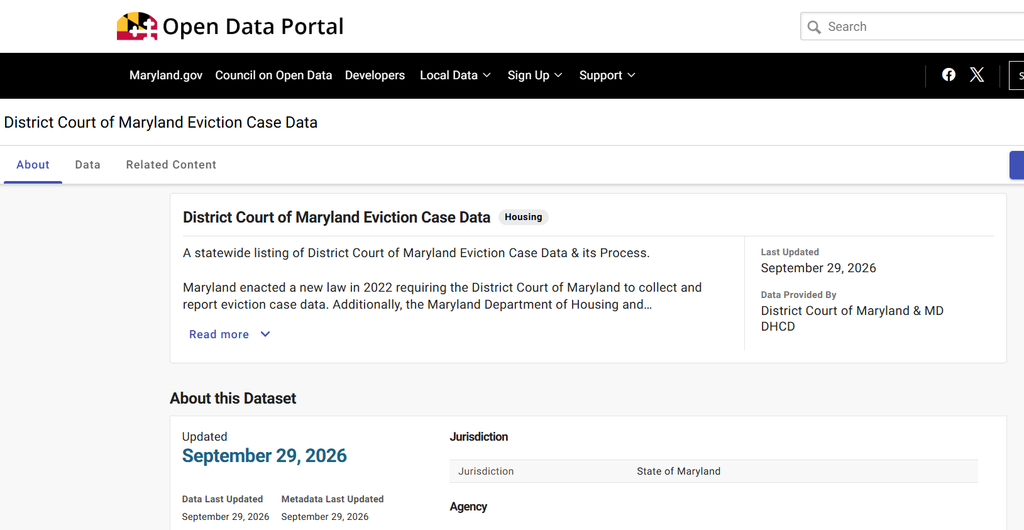
What Are Maryland Eviction Records?
Maryland eviction records are court records connected with legal actions involving possession of rental property. They can contain information about the parties, case number, filing date, case type, hearings, judgments, and disposition.
The Maryland Judiciary explains that Case Search provides a summary of information contained in an official court file. It is useful for finding basic case information, but it does not provide every document in the complete court record.
Eviction Is Not One Case Type
A common mistake is to search only for a case labeled “eviction.” Maryland landlord-tenant disputes can involve several different actions.
Common case types include:
- Failure to Pay Rent: Used when a landlord claims rent is unpaid and seeks possession of the property.
- Tenant Holding Over: Used when a tenant remains after the lease has ended or after required notice.
- Breach of Lease: Used when a landlord alleges that the tenant violated a lease provision.
- Wrongful Detainer: Used in certain situations where someone is unlawfully possessing property.
- Warrant of Restitution: A court process associated with enforcing a judgment for possession.
The Maryland Courts identify Failure to Pay Rent, Tenant Holding Over, and Breach of Lease as important landlord-tenant actions that can lead to eviction proceedings.
Where to Search Maryland Eviction Records
The primary online starting point is the Maryland Judiciary Case Search.
Case Search provides public access to qualifying records from Maryland District Courts and Circuit Courts. The system can be searched using information such as a person’s name and other case details.
Search by Tenant Name
If you are trying to determine whether a person has an eviction-related court case, a name search is usually the most practical starting point.
Enter the person’s legal name as accurately as possible. Maryland Case Search currently defaults to exact-name searches. For partial searches, the Judiciary instructs users to enter at least the first character of the last name followed by the % symbol.
When multiple results appear, compare:
- Full name
- Court
- County
- Case number
- Filing date
- Case type
- Case status or disposition
Do not assume that every case involving someone with the same name belongs to the person you are researching.
Search by Case Information
If you already know a case number, filing date, county, or other identifying information, use it to narrow the search.
This can be particularly helpful for common names. Maryland Judiciary notes that searches producing more than 600 results need to be narrowed using additional information such as the filing date, court, case type, or first name.
How to Search Maryland Eviction Records Online
A careful search should involve more than entering a name and accepting the first result.
Step 1: Open Case Search
Go to the official Maryland Judiciary Case Search website. Review the site’s access notice before continuing.
Step 2: Enter the Person’s Name
Use the tenant’s name as accurately as possible. If the exact spelling is unknown, Maryland’s partial-name search rules can help narrow the results.
Step 3: Review the Results
Look for civil cases that appear connected to landlord-tenant activity. Pay attention to the case type rather than relying only on words such as “eviction.”
Step 4: Check the Case Details
Review the case number, filing date, parties, court, and disposition. These details help distinguish a genuine eviction-related case from an unrelated civil matter.
Step 5: Get the Complete Court File if Necessary
Case Search is not the same as viewing the complete court file. Maryland Courts states that the online system provides selected information and that complete records may need to be reviewed through the appropriate Clerk’s Office.
For a paper record, contact the courthouse where the case was heard. The clerk may be able to locate the file using the case number or names of the parties. Copies of documents may involve a fee.
What Information Can an Eviction Record Show?
The information available depends on the case and whether any access restrictions apply.
A public Case Search result may help you identify:
| Information | What It Tells You |
|---|---|
| Case number | The unique identifier for the court case |
| Parties | Names of the plaintiff and defendant |
| Filing date | When the case was initiated |
| Court | Where the case was filed |
| Case type | The legal action involved |
| Case events | Important actions recorded in the case |
| Disposition | How the case ended or its current status |
| Judgment information | Whether a judgment was entered |
The Maryland Judiciary describes Case Search as a source for general case information, while the underlying court file contains the more complete record.
Understanding Common Maryland Eviction Case Types
Knowing the terminology is important because an eviction-related record does not always mean the tenant was physically removed.
Failure to Pay Rent
A Failure to Pay Rent case is generally filed when a landlord claims that rent remains unpaid. Maryland Courts explains that this action can be used to seek eviction and potentially monetary damages.
Maryland has also changed how these records are treated publicly. Under Real Property § 8-503, a Failure to Pay Rent proceeding that does not result in a judgment of possession must be shielded by the District Court within 60 days after final resolution.
That distinction is important: a filed case does not necessarily mean the landlord obtained possession of the property.
Tenant Holding Over
A Tenant Holding Over case generally involves a tenant who remains in the property after the lease has ended or after the required notice to vacate.
Maryland Courts describes Tenant Holding Over as a landlord-tenant action seeking repossession when the tenant has not vacated after notice.
Breach of Lease
A Breach of Lease action can involve an alleged violation of the rental agreement other than simply failing to pay rent.
The exact circumstances and available remedies depend on the lease, the allegations, and the court proceedings. Maryland Courts lists breach of lease as one of the landlord-tenant actions that may be used to seek eviction.
Wrongful Detainer
Wrongful Detainer is another civil action that can appear in Maryland court records involving possession of property. It should not automatically be treated as identical to a Failure to Pay Rent case.
The Maryland Judiciary’s current District Court forms include a Complaint for Wrongful Detainer, confirming that it is a separate court action.
Does an Eviction Filing Mean Someone Was Evicted?
No.
This is one of the most important points when interpreting Maryland eviction records.
A landlord can file a case without ultimately obtaining possession. A case may be dismissed, resolved between the parties, or otherwise concluded without an eviction taking place.
For Failure to Pay Rent cases, Maryland law now specifically distinguishes proceedings that end without a judgment of possession. Those records are subject to automatic shielding after final resolution.
Therefore, a responsible record search should examine the case outcome, not simply the existence of a filing.
Judgment for Possession
A judgment for possession means the court has ruled in favor of the landlord’s right to possession in the relevant proceeding.
Maryland Courts explains that when a court enters a judgment for possession, the landlord may take the next steps in the eviction process.
A judgment for possession and an actual completed physical eviction are related but are not necessarily the same event.
Are Maryland Eviction Records Public?
Many Maryland court records are generally open to the public, but access is subject to exceptions.
The Maryland Judiciary states that records that have been expunged, shielded, or sealed are not available to the public. The state also now has specific rules affecting Failure to Pay Rent cases.
This means that public availability can depend on:
- The type of case
- The case outcome
- Whether the record was shielded
- Whether a court order restricts access
- The date and circumstances of the proceeding
Automatic Shielding of Certain Cases
Under Maryland Real Property § 8-503, if a Failure to Pay Rent proceeding does not result in a judgment of possession, the District Court must shield the court records within 60 days after the final resolution.
The Maryland General Assembly enacted this change through 2024 legislation concerning the shielding of Failure to Pay Rent proceedings. The legislation became effective in stages, including provisions effective August 1 and October 1, 2024.
Can a Maryland Eviction Record Be Shielded?
In some circumstances, yes.
Shielding is different from simply deleting a case from the court system. It limits public access to the record.
Cases Without a Judgment of Possession
Certain Failure to Pay Rent cases that do not result in a judgment of possession are automatically shielded within 60 days after final resolution.
Cases With a Judgment of Possession
A tenant may ask the District Court to shield a Failure to Pay Rent record that resulted in a judgment of possession under specified circumstances.
Maryland law allows a tenant to request shielding when the tenant exercised the right of redemption and at least 12 months have passed since final resolution, or when the court determines there is good cause to shield the record.
The Maryland Judiciary currently provides forms including DC-CV-119, Petition to Shield a Failure to Pay Rent Action Record, and DC-CV-116 for certain COVID-19-related cases.
What Is the Difference Between Shielding and Expungement?
These terms should not be used interchangeably.
Shielding limits public access to an eligible court record. The underlying record can still exist.
Expungement is a different legal process and is most commonly discussed in connection with eligible criminal records. Maryland Courts specifically distinguishes expungement from shielding.
For Maryland eviction-related civil cases, the relevant issue is generally shielding, not criminal-record expungement.
Why You May Not Find an Eviction Record
A missing result does not always prove that no case existed.
Several explanations are possible.
The Case Was Shielded
If a qualifying Failure to Pay Rent case was shielded, it will not be available to the public in the ordinary way.
The Search Information Is Incorrect
A misspelled name, different legal name, or incomplete information can produce misleading results.
The Case Is Outside the Available Online Information
Maryland Case Search has historical coverage, but the Judiciary notes that some older civil cases may be in a history database and unavailable through the ordinary Case Search display.
You Are Looking at the Wrong Case Type
Searching only for “Failure to Pay Rent” can miss other landlord-tenant actions, including Tenant Holding Over or Breach of Lease.
The Complete File Is Not Online
Case Search provides selected case information rather than every document in the court file. For complete documentation, the appropriate clerk’s office may need to be contacted.
How Landlords and Tenants Should Read These Records
An eviction record should be interpreted in context.
For landlords or property researchers, the important question may be whether a court entered a judgment for possession, not merely whether a complaint was filed.
For tenants, it may be important to determine whether the case was dismissed, resolved without possession, resulted in a judgment, or was later shielded.
A useful review should therefore consider:
- Why was the case filed?
- What type of landlord-tenant action was used?
- What happened at the hearing or afterward?
- Was there a judgment for possession?
- Was the case later shielded?
- Does the online result represent the complete court record?
This approach prevents a filing from being incorrectly described as a completed eviction.
Maryland Eviction Records by County
Maryland does not require a person to use a separate eviction database for every county. State court records are accessible through the Maryland Judiciary’s Case Search system when the records are publicly available.
The relevant court is generally connected to the location of the rental property and the type of proceeding.
If an online search does not provide enough information, the next step may be contacting the clerk of the District Court where the case was filed or heard. Maryland Courts maintains a directory of court locations and contact information.
This is especially useful when researching older cases or obtaining documents that are not displayed through Case Search.
Common Mistakes When Searching Eviction Records
Assuming Every Eviction Case Means an Actual Eviction
A filing alone does not establish that the tenant was physically removed.
Ignoring the Case Disposition
The outcome is often more important than the initial filing.
Treating Case Search as the Complete File
Case Search is a summary and does not provide every document maintained by the court.
Searching Only One Legal Term
Use the relevant landlord-tenant case types rather than relying on the word “eviction.”
Assuming a Missing Result Means No Case Existed
Shielding and limitations on online access can affect what the public can see.
Frequently Asked Questions
How do I find an eviction case in Maryland?
Start with the Maryland Judiciary Case Search and search by the tenant’s name. Review civil case results and look for landlord-tenant case types such as Failure to Pay Rent, Tenant Holding Over, Breach of Lease, or Wrongful Detainer.
Are Maryland eviction records public?
Many court records are generally public, but Maryland law provides exceptions. Certain Failure to Pay Rent cases are automatically shielded, while other cases may be shielded under specific circumstances.
Does a Failure to Pay Rent case mean the tenant was evicted?
No. A case can be filed without resulting in a judgment for possession or an actual eviction. The case disposition and judgment information should be reviewed before drawing a conclusion.
How long does an eviction stay on Maryland Case Search?
There is no single simple period that applies to every eviction-related case. Public availability depends on the type of proceeding, its outcome, and whether the record has been shielded or otherwise restricted. Certain Failure to Pay Rent cases without a judgment of possession must be shielded within 60 days after final resolution.
Can a tenant request an eviction record to be shielded?
Yes, certain Failure to Pay Rent cases may qualify for shielding upon a tenant’s motion. Maryland law provides specific circumstances involving redemption and the passage of at least 12 months, as well as a separate good-cause standard.
Where can I get the complete Maryland eviction case file?
The appropriate Clerk’s Office can provide access to court records maintained at the courthouse, subject to applicable access rules. Case Search should be treated as a source of case information rather than a complete copy of the file.
Final Thoughts
Maryland eviction records are primarily court records, and the most useful starting point is the Maryland Judiciary Case Search system. A proper search should go beyond the word “eviction” and consider the different landlord-tenant actions used by Maryland courts.
The case type, filing date, parties, disposition, and judgment information can help explain what actually happened. It is also important to understand Maryland’s newer shielding rules, because qualifying Failure to Pay Rent cases may no longer be visible to the general public.
For a basic search, Case Search is usually sufficient. When the result is unclear or a complete record is needed, contacting the appropriate District Court Clerk’s Office is the better next step. This combination of online research and official court records provides a more accurate picture than treating a single case listing as proof of an actual eviction.