Maryland foreclosure records can help you determine whether a property is involved in a foreclosure case, find the status of a foreclosure sale, review court filings, and trace what happened to a property after a sale. However, there is no single public database containing every Maryland foreclosure record.
The most useful source depends on what you are trying to find. Maryland Judiciary Case Search is the primary starting point for foreclosure cases. Maryland land records can help verify deeds, liens, and other recorded documents. The Maryland Department of Assessments and Taxation (SDAT) provides property ownership and assessment information, while the Maryland Office of Financial Regulation maintains foreclosure-related data and registrations that are not all publicly accessible.
This guide explains how these systems fit together and how to use them without confusing a foreclosure case with a completed foreclosure sale.
What Are Maryland Foreclosure Records?
Maryland foreclosure records are documents and information created during the legal process used to enforce a mortgage or deed of trust after a borrower defaults.
A foreclosure record may show information such as:
- The names of parties involved in the case
- The property connected with the foreclosure
- The court where the case was filed
- The foreclosure case number
- Court filings and docket activity
- Notices related to the foreclosure
- The scheduled sale
- Information about the sale and its subsequent court ratification
The exact information available depends on the stage of the case and the record system being searched.
Foreclosure Case vs. Property Record
One of the most important distinctions is that a foreclosure case is not the same thing as a land record.
The Maryland Courts specifically state that foreclosure cases are handled by the Civil Clerk of the Circuit Court and can be located through Maryland Case Search. They are not maintained as foreclosure cases within the Department of Land Records.
Land records can still become important later because deeds, liens, and other instruments affecting title may be recorded there.
Foreclosure vs. Tax Sale
A mortgage foreclosure should also be distinguished from a Maryland tax sale foreclosure.
A tax sale generally begins when delinquent property taxes or other eligible charges result in a tax lien being sold. The tax-sale lien purchaser can later file a civil action to foreclose the owner’s right of redemption if the property is not redeemed within the applicable period.
Therefore, someone researching a property should determine whether they are looking for a mortgage foreclosure, a tax-sale matter, or another type of lien enforcement.
Where to Search Maryland Foreclosure Records
There are several important sources, and each serves a different purpose.
| Resource | Best for |
|---|---|
| Maryland Judiciary Case Search | Foreclosure court cases and case activity |
| Maryland Land Records / MdLandRec | Deeds, liens and other recorded land documents |
| SDAT Real Property Search | Property ownership, assessment and sales information |
| Office of Financial Regulation | Foreclosure notices, registrations and statewide data |
| Local newspapers | Published foreclosure sale notices |
| Circuit Court Clerk | Access to court records and local record assistance |
Using more than one source is often necessary to build an accurate picture of a property’s foreclosure history.
How to Search a Maryland Foreclosure Case
Start With Maryland Case Search
The Maryland Judiciary provides public access to case records originating in the Circuit and District Courts through its Case Search system.
For a foreclosure investigation, the owner’s name is often a useful starting point.
The Maryland Courts’ land-record guidance specifically says that a person can look up a foreclosure case by searching the owner’s name through Maryland Case Search.
Search the Owner’s Name Carefully
Name searches can produce multiple results, especially when a person has a common name.
Check:
- The spelling of the owner’s name.
- The county where the property is located.
- The type of court case.
- The filing date.
- The property address or other identifying information shown in the case.
- Whether the case appears to involve a mortgage or deed of trust.
Maryland Case Search has specific search behavior for exact and partial names. The Judiciary notes that the system defaults to exact-name searches and provides instructions for partial-name searches.
Review the Case Details
Finding a matching case is only the first step.
Review the available case information to determine whether the matter is:
- Recently filed
- Moving through the foreclosure process
- Subject to mediation
- Associated with a scheduled sale
- Already sold
- Awaiting court ratification
- Closed or otherwise resolved
A foreclosure case appearing in Case Search does not automatically mean that the property has already been sold.
How to Check a Property Address
If you know the property address but not the owner’s name, SDAT is useful for identifying the property and current or recorded ownership information.
The Maryland Department of Assessments and Taxation’s Real Property Data Search allows users to search property records by county and available property identifiers. SDAT provides ownership, value, and sales information for Maryland real property.
Use SDAT to Identify the Property
A practical workflow is:
- Open the Maryland Real Property Data Search.
- Select the appropriate county.
- Search using the property address or account identifier.
- Review the property information.
- Note the owner’s name and property account number.
- Use the owner’s name to search Maryland Case Search.
SDAT’s official instructions explain that address searches have specific formatting requirements. For example, the system may require users to omit street suffixes or directions when entering an address.
This makes SDAT particularly useful when you begin with a street address rather than a person’s name.
How to Search Maryland Land Records
Maryland land records are useful when you need to examine documents affecting a property’s title.
The Maryland Judiciary provides online access to land record documents through MdLandRec, while plats can be accessed through Plats.net.
What Land Records Can Show
Depending on the property and documents recorded, land records may help you review:
- Deeds
- Mortgages
- Deeds of trust
- Liens
- Releases
- Assignments
- Other instruments affecting title
However, land records should not be treated as a substitute for a foreclosure case search.
Maryland Courts expressly distinguish foreclosure cases from land records. A foreclosure case is handled through the Circuit Court, while land records contain recorded property documents.
Find the Deed Reference
SDAT can help you identify a property’s deed reference. Maryland Courts explains that deed references identify the book and page where the document is stored, and the reference can be found through property information.
This can make a land-record search much easier when you need to trace ownership or title documents.
How Foreclosure Records Develop
A foreclosure record does not appear all at once. Different documents are created at different stages.
Notice of Intent to Foreclose
For many residential mortgage foreclosures, the process begins with a Notice of Intent to Foreclose.
Maryland law generally requires the secured party to send this notice at least 45 days before filing a foreclosure action involving residential property, subject to statutory exceptions. The notice is sent by certified mail and first-class mail.
The Maryland Office of Financial Regulation explains that the notice warns the homeowner that a foreclosure action could be filed in court.
Importantly, receiving or finding information about a Notice of Intent does not necessarily mean a foreclosure case has already been filed.
Foreclosure Filed in Court
The next major stage is the filing of the foreclosure action.
For residential property, Maryland’s process can involve an Order to Docket or a complaint to foreclose a mortgage or deed of trust. The Office of Financial Regulation describes the Order to Docket as the first court filing that initiates the foreclosure process.
This is where Maryland Case Search becomes particularly important.
Mediation and Other Proceedings
Certain owner-occupied residential foreclosure cases may involve loss mitigation and foreclosure mediation procedures.
Maryland law provides specific requirements concerning prefile and postfile mediation, including circumstances in which a homeowner may request mediation.
For someone researching a public record, this means the case docket can contain activity between the initial filing and any eventual sale.
How to Find a Maryland Foreclosure Sale
A scheduled foreclosure sale is different from the initial foreclosure filing.
Maryland law requires notice of the time, place, and terms of a foreclosure sale to be published in a newspaper of general circulation in the county where the action is pending. The statutory publication schedule requires publication at least once a week for three successive weeks, subject to the timing requirements in the statute.
Check Local Legal Notices
Local newspapers can therefore be useful when you are specifically trying to identify upcoming foreclosure auctions.
A Maryland Circuit Court FAQ notes that the courts do not maintain a simple list of all properties being foreclosed and points users toward legal notices in local newspapers for information about properties going to foreclosure.
This is one reason a search based only on a general property database may miss information about an upcoming sale.
Confirm the Sale in Court Records
If you find a published auction notice, check the associated court case.
Look for information showing:
- The scheduled sale date
- The sale location
- The person or entity authorized to conduct the sale
- Subsequent filings concerning the sale
- The report of sale
- Court ratification
This second check helps distinguish a published notice from a completed and approved foreclosure transaction.
What Happens After a Foreclosure Sale?
A foreclosure auction does not necessarily mean the transaction is immediately final.
The Maryland Office of Financial Regulation explains that, after a foreclosure sale, the homeowner generally has 30 days from the date of the Notice of Report of Sale to file exceptions. If no valid exceptions remain, the court can ratify the sale.
Court Ratification Matters
Court ratification is an important milestone when reviewing foreclosure records.
The sale and the court’s subsequent approval are separate events. The Maryland Office of Financial Regulation states that ratification is necessary before title transfers to the purchaser.
For that reason, someone researching a property should not assume that an auction notice alone proves that ownership has changed.
Check the Deed Afterward
Once the foreclosure transaction progresses to the point where ownership is transferred, land records can become useful for confirming the recorded transfer.
This creates a practical sequence:
Property search → Case Search → Sale information → Court ratification → Land records
The exact timing and documents can vary by case.
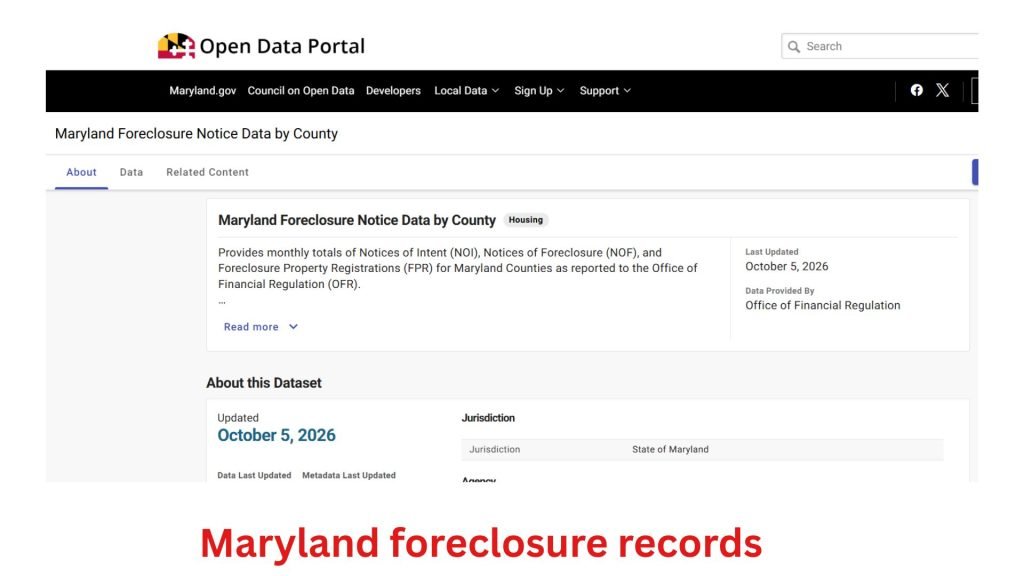
Maryland Foreclosure Registration and State Data
The Maryland Office of Financial Regulation operates the state’s Foreclosure Registration System.
The system receives certain foreclosure-related notices and registrations, including the Notice of Intent to Foreclose, Notice of Foreclosure, and information associated with foreclosed properties.
Is the Foreclosure Registration System Public?
Not completely.
OFR states that the Maryland Foreclosure Registration System is not available for general public use, except for limited property-specific information under certain criteria. The underlying records are accessible to authorised parties.
This is an important distinction because users may assume that every state foreclosure filing can be searched through one public database.
Foreclosure Data Tracker
OFR also publishes foreclosure data for analysis.
The state’s Foreclosure Data Tracker uses information submitted through the Maryland Foreclosure Registration System. However, OFR warns that the data may contain duplicates or errors and does not constitute official foreclosure case records.
For a specific property’s legal status, court records should therefore take priority over aggregate foreclosure statistics.
How to Verify a Foreclosure Property
If you are researching a property before buying, investing, or conducting title research, do not rely on one database.
Use Multiple Records
A stronger verification process is:
- Search SDAT to identify the property and owner.
- Search Maryland Case Search using the owner’s name.
- Review the foreclosure case and its docket activity.
- Check published sale notices if an auction is involved.
- Review Maryland land records for recorded title documents.
- Compare dates and names across the records.
- Confirm the latest available information before making a decision.
Watch for Date Differences
Foreclosure information can appear at different times across different systems.
For example, a court case may show a foreclosure filing before a sale occurs. A sale notice may appear before the court later ratifies that sale. A land record may be recorded after the court proceeding reaches a later stage.
Do not interpret an isolated date as proof of the property’s current ownership or foreclosure status.
Common Mistakes When Searching
Searching Only Land Records
Land records are valuable, but Maryland Courts specifically state that foreclosure cases are not maintained there. Start with the Circuit Court case system when looking for a foreclosure proceeding.
Assuming a Foreclosure Means a Sale Occurred
A filed foreclosure case can remain active without an immediate sale.
Always look for evidence of a scheduled sale and, where relevant, subsequent court action.
Confusing Tax Sales With Mortgage Foreclosures
A tax-sale lien and a mortgage foreclosure are different legal matters. If you are investigating delinquent property taxes, use the appropriate tax-sale resources in addition to mortgage foreclosure records.
Relying on Third-Party Lists Alone
Commercial foreclosure lists can be useful for finding leads, but they should be verified against official records.
The Maryland Office of Financial Regulation itself cautions that its public foreclosure data does not constitute official court case records.
Frequently Asked Questions
Can I search Maryland foreclosure records online?
Yes. Maryland court case information can be searched online through Maryland Judiciary Case Search. Maryland land documents can also be accessed online through MdLandRec. SDAT provides online property ownership, assessment, and sales information.
Can I search for a foreclosure by property address?
An address is useful for identifying the property through SDAT, but Maryland Courts recommend searching for foreclosure cases through Maryland Case Search, including by the owner’s name. A practical approach is to identify the owner from SDAT and then search the court records.
Does Maryland have a statewide foreclosure list?
There is not a simple public statewide list of every active foreclosure property. Maryland foreclosure information is distributed across court records, land records, state foreclosure data, and published legal notices. A Maryland Circuit Court FAQ also notes that the court does not maintain a simple list of properties in foreclosure.
Are Maryland foreclosure records public?
Many foreclosure court records are available to the public through Maryland Judiciary systems, subject to applicable access rules and restrictions. However, not every foreclosure-related state registration is publicly accessible. OFR says its Foreclosure Registration System is restricted to authorised users except for limited property-specific information.
How can I tell whether a foreclosure sale was completed?
Look beyond the initial foreclosure filing. Review the case for sale-related filings, the report of sale, and court action concerning ratification. Maryland’s foreclosure process requires court ratification before title transfers to the purchaser.
Where can I verify the property’s current owner?
SDAT is a useful starting point for property ownership information, while Maryland land records can be used to examine recorded deeds and other title documents. For a legally significant ownership determination, consider professional title research rather than relying solely on an online property database.
Final Takeaway
Maryland foreclosure records are spread across several systems because different agencies maintain different parts of the property and legal record.
For most searches, Maryland Judiciary Case Search should be the starting point for identifying a foreclosure case. SDAT can help connect a property address with an owner and property account, while MdLandRec is valuable for reviewing recorded deeds, liens, and other land documents. Published legal notices can help identify foreclosure sales, and the Office of Financial Regulation provides statewide foreclosure data and manages registrations that are not entirely public.
The most reliable approach is to compare multiple official records rather than treating one search result as the complete history. This is especially important when determining whether a property is merely involved in a foreclosure case, scheduled for auction, sold at auction, or has completed the court ratification and ownership-transfer process.