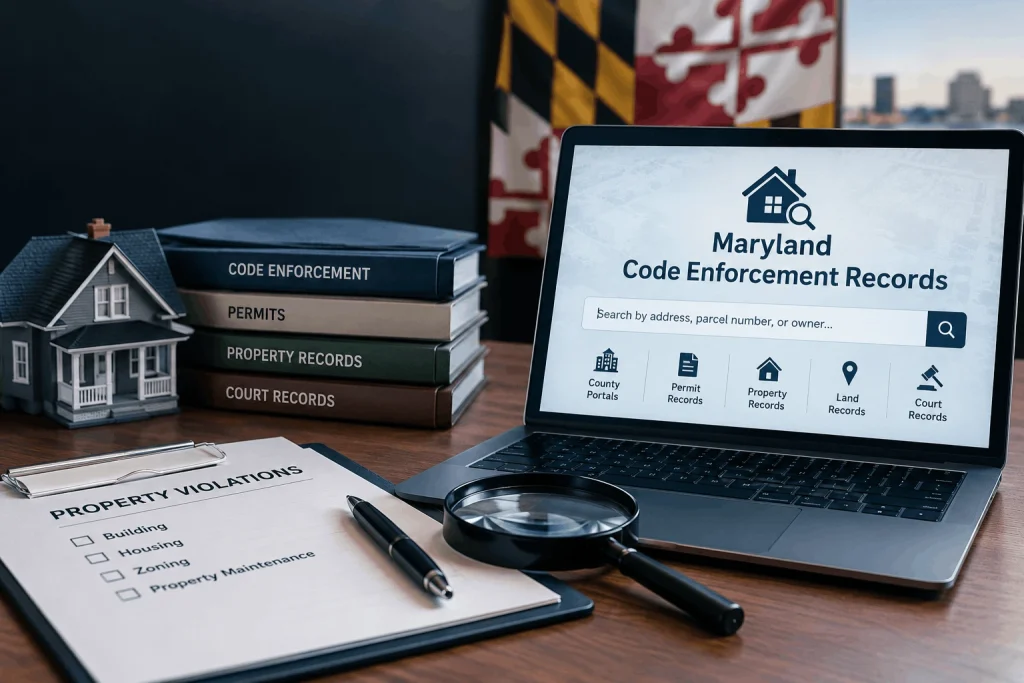
Maryland Code Enforcement Records are generally maintained by the county or municipality responsible for enforcing local property, building, housing, and zoning requirements. Maryland does not have one statewide public search tool containing every local code enforcement case, so the right place to search depends on where the property is located. A records search may involve a county enforcement portal, a public information request, permit records, property records, land records, or court records.
This distinction matters when researching a property. The Maryland Department of Assessments and Taxation (SDAT) provides property information such as ownership, assessments, and sales data, but it is not the statewide repository for local code violations. Local jurisdictions maintain and enforce their own applicable codes and records.
What Are Maryland Code Enforcement Records?
Code enforcement records document actions taken when a property, building, business, or other activity may not comply with applicable local requirements.
Depending on the jurisdiction, a file may relate to:
- Property maintenance conditions
- Building or construction issues
- Zoning violations
- Unsafe or deteriorated structures
- Unpermitted work
- Illegal occupancy
- Trash, debris, or exterior property conditions
- Rental or licensing violations
- Sign violations
- Vacant or abandoned properties
- Commercial property concerns
- Other local code violations
The exact categories vary between counties and municipalities because local governments administer their own codes and enforcement programs.
What May Appear in a Record?
A code enforcement file can contain different information depending on the agency and case. Possible records include:
- Property address
- Case or complaint number
- Date of inspection
- Description of an alleged violation
- Inspection findings
- Notices sent to an owner or occupant
- Compliance deadlines
- Photographs or supporting documents
- Citations or enforcement actions
- Status of the case
- Fines or penalties
- Information about corrective action
Not every item will necessarily be available online. Some records may require contacting the responsible agency or submitting a Maryland Public Information Act request.
Why Search Code Enforcement Records?
People search these records for several practical reasons. A prospective buyer may want to know whether a property has unresolved compliance problems. An owner may need to check the status of a case. A tenant or neighbor may want to understand an enforcement action affecting a property.
Before Buying a Property
Code violations can be important during real estate due diligence.
A property record may show ownership and assessment information, but those records do not necessarily tell you whether the local government has an active enforcement case. Maryland’s SDAT database provides statewide real property information, including ownership, value, and sales data.
For a more complete review, compare the property record with local enforcement information, permits, and applicable land or court records.
When Checking an Existing Property
Property owners may need records to determine:
- Why an enforcement notice was issued
- Whether an inspection occurred
- What correction is required
- Whether a case remains open
- Whether additional documentation is needed
The agency responsible for the case is usually the best source for the current status.
When Researching a Neighborhood
Code enforcement information can also help someone understand recurring property maintenance or zoning concerns in a particular area. However, enforcement data should be interpreted carefully. A complaint does not automatically mean a violation was confirmed, and an old case does not necessarily mean the property remains out of compliance.
How to Search Maryland Code Enforcement Records
The most effective approach is to start with the property’s exact location and then identify the government agency responsible for enforcement.
Step 1: Identify the County or Municipality
First determine where the property is located.
This is particularly important in Maryland because incorporated municipalities may have their own local authority and enforcement offices. The Maryland Department of Assessments and Taxation maintains information on Maryland’s incorporated municipalities and their relationship to county property records.
A property inside a city or town may therefore need to be researched through that municipality rather than only through the county.
Step 2: Gather the Property Address
Use the complete street address when possible.
You can also use the Maryland SDAT Real Property Data Search to identify the property and obtain its property account information. SDAT allows searches using information such as an address, street name, account identifier, or map reference.
If an address search does not work, SDAT recommends adjusting the search format. Its instructions explain that street directions and street-type suffixes should generally be omitted when searching by address.
Step 3: Find the Local Enforcement Agency
Search the county or municipality’s official website for terms such as:
- Code Enforcement
- Property Maintenance
- Housing Code Enforcement
- Permitting and Inspections
- Planning and Zoning
- Code Compliance
- Enforcement Division
- Property Standards
The agency name is not uniform throughout Maryland.
For example, Prince George’s County’s Department of Permitting, Inspections and Enforcement (DPIE) includes property code enforcement among its services and has an Enforcement Division responsible for property maintenance standards and certain zoning laws.
Step 4: Search the Local Online Portal
Some jurisdictions provide online case-search tools.
Baltimore County, for example, provides a Community Code Enforcement search through its Accela Citizen Access system. Users can search for a specific case using a street address or case number, while additional search fields include ZIP code and dates.
Where an online search is available, try the property’s:
- Street number
- Street name
- ZIP code
- Case number, if known
If the system returns multiple cases, compare the addresses and dates before deciding that a record belongs to the property you are researching.
Step 5: Request Records if They Are Not Online
An online portal may not contain every document associated with a case.
Maryland’s Public Information Act generally provides a right to inspect public records, subject to statutory exceptions. State law says that, unless otherwise provided by law, a custodian shall allow a person or governmental unit to inspect a public record at a reasonable time.
The law also states that Maryland’s public-record provisions are generally construed in favor of access while accounting for privacy and other legal limitations.
If the record is not available online, contact the agency’s records custodian or follow its public-record request procedure.
What Information Do You Need for a Search?
The more identifying information you have, the easier it is to locate the correct case.
Minimum Information
Start with:
- Property street address
- County or municipality
- ZIP code
Helpful Additional Information
If available, also collect:
- Property account number
- Parcel or tax account information
- Case number
- Previous address formats
- Approximate inspection date
- Owner name
- Permit number
The SDAT property database can be particularly useful for confirming the property’s account information. However, SDAT itself explains that its real property system is intended for property information and is not a replacement for local tax or enforcement records.
Maryland Public Information Act Requests
When a local agency does not provide the desired enforcement information through an online portal, a public-record request may be appropriate.
What to Request
A narrowly written request is usually easier for an agency to process. Depending on your purpose, you might request records relating to:
- A specific property address
- A particular code enforcement case
- Inspection reports
- Notices of violation
- Compliance orders
- Citations
- Photographs
- Closure or abatement documentation
- Records showing the current case status
Avoid requesting “everything” unless you genuinely need a broad collection of records. A precise request can make it easier to identify the relevant file.
Are All Records Public?
No.
Maryland’s Public Information Act contains exceptions and limitations. Public access can depend on the type of record, privacy considerations, and other provisions of law. The state’s statute establishes the general right of access but does not make every government document automatically available without restriction.
An agency may therefore provide some portions of a file while withholding or redacting information that is legally protected.
Code Violations and Property Records Are Different
One of the most important points in a Maryland records search is that a property record and a code enforcement record serve different purposes.
SDAT Property Records
Maryland SDAT provides property information such as:
- Ownership information
- Property value
- Sales information
- Property account details
- Assessment-related information
Its Real Property Data Search covers properties throughout Maryland.
Local Code Enforcement Records
Local enforcement offices may maintain information about:
- Complaints
- Inspections
- Violations
- Notices
- Compliance actions
- Property maintenance issues
- Zoning enforcement
These records generally need to be obtained from the county or municipality responsible for the property.
Land and Lien Records
An unresolved enforcement matter may sometimes lead to a lien or another recorded legal action. That is why a property investigation should not stop after checking an enforcement portal.
Maryland’s Judiciary provides online access to land-record documents through MdLandRec, while its court-record resources include Case Search and other systems.
Check Court Records When Appropriate
Not every code violation becomes a court case. However, some disputes, penalties, judgments, or related proceedings may eventually involve the courts.
Maryland Judiciary Case Search provides public access to case information from Maryland District and Circuit Courts, subject to applicable access restrictions.
What Court Records Can Tell You
A court search may help identify:
- A related civil case
- A judgment
- A dispute involving enforcement
- A case number
- Parties involved
- Filing dates
- Case status or disposition
Case Search should not be treated as a substitute for the local code enforcement file. Maryland Courts specifically explains that Case Search provides a summary of information in the official case file and that the complete record may need to be reviewed through the clerk’s office.
Check Permits for Unpermitted Work
A code enforcement concern may involve construction or alterations that required approval.
If a property appears to have additions, conversions, renovations, decks, accessory structures, or other work that may have required authorization, checking permit records can provide important context.
For example, Prince George’s County directs users to its permit-history resources when verifying whether a permit exists for a property.
A missing permit does not automatically prove that a property has an active code violation. Permit requirements vary according to the work, location, and applicable regulations, so the responsible permitting office should be consulted.
Common Maryland Code Enforcement Issues
The actual violations vary by jurisdiction, but recurring categories can include property maintenance and zoning concerns.
Exterior Property Conditions
Examples may include:
- Accumulated trash
- Debris
- Overgrown vegetation
- Unsafe exterior conditions
- Deteriorated structures
- Improper outdoor storage
Prince George’s County, for example, identifies tall grass, trash, debris, open storage, and certain vehicle conditions among matters that can be reported through its local service-request system.
Housing and Interior Conditions
Enforcement can also involve conditions inside residential properties, particularly where local housing or property-maintenance standards apply.
Prince George’s County identifies interior unit concerns, sanitation issues, and pest infestation concerns among common residential enforcement categories.
Zoning and Business Activity
Code enforcement can also overlap with land-use requirements.
Potential issues include:
- Unauthorized business activity
- Improper commercial use
- Illegal signs
- Unapproved structures
- Zoning violations
- Certain rental or occupancy issues
The responsible department and applicable rules depend on the property’s jurisdiction.
What If You Find an Open Violation?
Finding an open case does not automatically mean that a property cannot be sold or occupied. The consequences depend on the type of violation, local law, case status, and any outstanding penalties or requirements.
Confirm the Current Status
Do not rely solely on the date of the original complaint.
Ask the responsible agency whether the case is:
- Open
- Resolved
- Closed
- Under review
- Appealed
- Awaiting inspection
- Subject to outstanding requirements
Ask What Must Be Done
If you are the owner or prospective buyer, determine exactly what remains outstanding.
For example, a file may involve a required repair, permit, inspection, cleanup, payment, or other compliance action.
Check for Related Liens or Court Actions
If the issue involves substantial penalties or prolonged noncompliance, check relevant land and court records as well. Maryland Judiciary provides separate systems for court records and land-record access, so these searches may reveal information that a local enforcement portal does not display.
How to Avoid Common Search Mistakes
A Maryland code enforcement search can produce misleading results if the records are interpreted without context.
Mistake 1: Searching Only SDAT
SDAT is useful for identifying a property, but its real property database is not a statewide code violation database.
Mistake 2: Assuming Every Complaint Is a Violation
A complaint can trigger an investigation without resulting in a confirmed violation.
Look for inspection findings, notices, case status, and final disposition.
Mistake 3: Ignoring Municipal Boundaries
A property inside an incorporated municipality may be subject to municipal enforcement procedures in addition to county-level requirements.
Mistake 4: Treating an Old Case as Current
An old enforcement record does not necessarily describe the property’s present condition. Always determine whether the case was closed or resolved.
Mistake 5: Using a Third-Party List as the Final Authority
Third-party databases can help locate information, but official county or municipal records should be used to verify important facts before making a legal, financial, or real estate decision.
Maryland Agencies and Resources to Know
The following resources can help when researching enforcement-related property information.
| Resource | Main purpose |
|---|---|
| Maryland Department of Assessments and Taxation | Property ownership, assessment and sales information |
| County or municipal code enforcement office | Local violations, inspections and enforcement |
| Planning and zoning office | Land-use and zoning information |
| Permitting office | Building and related permit information |
| Maryland Public Information Act | Process for requesting public records |
| Maryland Judiciary Case Search | Public court case information |
| MdLandRec | Maryland land-record documents |
| Maryland Department of the Environment | Environmental compliance and enforcement information |
The Maryland Department of the Environment also provides searchable compliance and enforcement information for environmental matters, including permits, inspections, complaints, and enforcement actions.
Frequently Asked Questions
Is there a statewide Maryland code enforcement search?
There is no single statewide public portal that functions as a complete database of all local property code enforcement cases. Enforcement is generally handled by the county or municipality with jurisdiction over the property.
Can I search code violations by property address?
Often, yes, but the process depends on the jurisdiction. Some local systems allow address-based searches, while others may require a case number or public-record request. Baltimore County’s code enforcement system, for example, supports searches by street address or case number.
Does Maryland SDAT show code violations?
SDAT’s Real Property Data Search provides property ownership, value, sales, and related assessment information. It should not be treated as a complete database of local code enforcement cases.
How can I find out if a property has an open violation?
Start with the local county or municipal code enforcement agency. Search its online enforcement system if available, then contact the agency or submit a public-record request if the information is not available online.
Can code enforcement records be requested under Maryland’s Public Information Act?
Public records are generally subject to inspection unless an applicable law permits or requires withholding. Maryland’s Public Information Act establishes this general right while also providing exceptions and limitations.
Do code violations appear in Maryland court records?
Only when a related matter reaches the court system. A local enforcement case does not automatically become a court case. Maryland Case Search can be useful for identifying related judicial proceedings, but it is separate from local code enforcement records.
Should I check code enforcement records before buying a Maryland property?
Yes, especially when the property has visible maintenance concerns, unusual construction, suspected unpermitted work, or other issues that could involve local regulations. A thorough review should combine local enforcement information with property, permit, land, and court records when appropriate.
Final Steps for a Reliable Search
A Maryland code enforcement records search works best when several sources are checked together. Begin with the exact property address and jurisdiction. Use SDAT to confirm the property and account information, then locate the appropriate county or municipal enforcement office.
If an online case search is available, review the case number, dates, violation description, inspection information, and status. When important documents are missing, contact the agency or use the Maryland Public Information Act process. For matters involving penalties, liens, judgments, or litigation, expand the search to Maryland land and court records.
Most importantly, verify current information directly with the government agency responsible for the property. Local records can differ in availability, terminology, and search methods, so the official custodian remains the strongest source for determining what a particular enforcement record means.