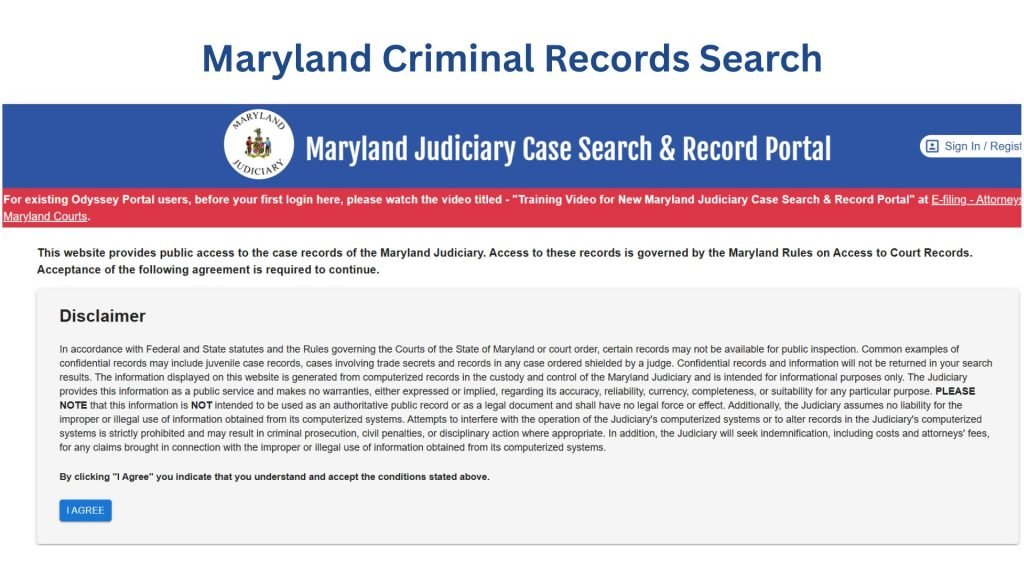
A Maryland criminal records search can mean two different things. One is searching publicly available court-case information through the Maryland Judiciary Case Search system. The other is obtaining an official criminal history record through Maryland’s Criminal Justice Information System (CJIS).
The difference matters because Case Search is designed to provide public information about court cases, not to serve as a formal criminal background-check service. Maryland Courts specifically states that Case Search should not be used for criminal background checks. Official background checks are handled through CJIS, which maintains Maryland’s fingerprint-supported criminal identification and criminal history information.
For most people, the right search method depends on what they need:
- Case information: Use Maryland Judiciary Case Search.
- A complete court file: Contact the clerk’s office or access the appropriate court record.
- An official Maryland background check: Use CJIS.
- Information that is no longer publicly displayed: Contact the appropriate courthouse or agency.
- A record that may have been removed or restricted: Check whether it was expunged, shielded, sealed, or otherwise restricted.
Understanding these differences can prevent an incomplete search or the mistaken assumption that no online result means no record exists.
How to Search Maryland Criminal Records Online
The Maryland Judiciary Case Search system is the main online resource for searching Maryland state court case information. It provides access to information from Maryland District Court and Circuit Court records, subject to public-access rules and restrictions.
Start With Maryland Case Search
Go to the Maryland Judiciary Case Search website and search using the information you have about the person or case.
A name search is usually the easiest starting point when you do not know the case number. Maryland’s current system defaults to exact-name searches. For a partial name search, the Judiciary says users can enter at least the first character of the last name followed by a % symbol.
When searching, use as much identifying information as appropriate, such as:
- Full legal name
- Correct spelling of the last name
- County, when known
- Case type
- Filing date or approximate date
- Case number, if available
- Date of birth when shown or otherwise available for identification
A common name can produce multiple results. Narrowing the search by county or filing date can make it easier to distinguish the correct person.
Review the Case Details
A Case Search result can provide useful information such as:
- Case number
- Names of parties
- Court
- Filing information
- Hearing dates
- Charges
- Case events
- Disposition information
However, Case Search is a summary rather than the complete official case file. Maryland Courts explains that the full record may contain documents and other information that are not displayed through the online search.
This distinction is especially important when the purpose of the search is legal, employment-related, or otherwise important.
What Information Can You Find?
A Maryland criminal case record may contain information about the criminal charge and what happened in the case.
Charges and Case Events
Search results can help identify the charge associated with a case and provide information about proceedings and case activity.
Finding a charge does not automatically mean the person was convicted. A case can end in several different ways, including dismissal, acquittal, nolle prosequi, a guilty finding, or other dispositions.
The disposition is therefore one of the most important parts of a criminal case search.
Understanding Case Dispositions
A disposition describes the outcome of a charge or case. Readers should avoid treating an arrest or filed charge as proof of guilt.
For example, a case showing a criminal charge does not necessarily mean that the defendant was convicted. Maryland Courts notes that records can exist for charges even when the person was not convicted.
When reviewing a result, look at the disposition and related case events instead of relying only on the charge description.
Why a Record May Not Appear Online
One of the most important limitations of a Maryland criminal records search is that not every criminal record will necessarily appear in the same way through Case Search.
Restricted and Confidential Records
Maryland law and court rules restrict public access to certain records. Examples include juvenile records and records that have been sealed, shielded, or expunged.
A missing result therefore does not always mean that a criminal case never existed.
Certain Criminal Charges Are Suppressed
Maryland has also changed how some criminal information appears in Case Search.
The Judiciary states that criminal or traffic charges with dispositions such as acquittal, dismissal, nolle prosequi, or not guilty may be automatically suppressed from Case Search under applicable law. Certain possession-of-cannabis cases are also subject to special rules.
The Judiciary’s current guidance also states that certain criminal charges entered as stet are removed from public Case Search after three years under the Expungement Reform Act of 2025.
For this reason, an online Case Search should not be treated as a complete historical inventory of every criminal event involving a person.
How to Get a Complete Criminal Case File
If the online search does not provide enough information, the next step may be the courthouse where the case was heard.
Contact the Clerk’s Office
Maryland Courts explains that court records are generally maintained by the clerk’s office at the courthouse where the case was filed or heard. A person requesting a record can provide the case number or, when necessary, information that helps the clerk locate the case.
The clerk’s office may be able to provide access to documents that are not available through the public Case Search interface.
Keep in mind that copying documents can involve fees, and access may still be restricted if the record is confidential or subject to a court order.
When Case Search Is Not Enough
A courthouse search may be particularly useful when:
- You need documents from the case file.
- A disposition is not clear from the online record.
- A criminal charge is no longer displayed online.
- You need a certified or official court document.
- You need to investigate an older case.
- You need information that is not included in the Case Search summary.
Maryland Courts specifically recommends contacting the courthouse when certain criminal charges are no longer displayed online but may still be available for public inspection.
Maryland Criminal Records vs. Background Checks
These terms are often used interchangeably, but they are not the same.
| Search Type | Main Purpose | Where to Start |
|---|---|---|
| Court case search | Find public information about Maryland court cases | Maryland Judiciary Case Search |
| Complete court file | Review documents and detailed case materials | Appropriate courthouse/clerk |
| Maryland criminal history check | Obtain official criminal-history information | CJIS |
| Employment or licensing check | Meet an authorized background-check requirement | CJIS and the requesting agency |
| Personal criminal-history review | Review your own eligible criminal-history information | CJIS |
The distinction is confirmed by Maryland Courts, which states that Case Search should not be used for criminal background checks and directs users to CJIS for that purpose.
How to Request an Official Maryland Background Check
The Maryland Department of Public Safety and Correctional Services operates the Criminal Justice Information System Central Repository, commonly called CJIS.
CJIS maintains Maryland’s fingerprint-supported criminal identification and criminal history record information.
Fingerprinting Requirements
For many official background checks, fingerprinting is part of the process. DPSCS states that applicants should provide valid government-issued photo identification and use the appropriate fingerprinting service or provider. Employment and licensing requests may also require information such as the agency name and authorization number.
The exact process depends on why the background check is being requested.
Examples include:
- Employment
- Professional licensing
- Government-related purposes
- Adoption
- Immigration or visa matters
- Individual review
Do not assume that one type of background check is interchangeable with another. The requesting organization may have specific authorization and fingerprinting requirements.
Can You Search Someone Else’s CJIS Record?
Not simply because you want to know their criminal history.
Maryland CJIS explains that criminal-history information is protected and is not generally available to the public without proper authorization. Its FAQ also states that individuals cannot request a background check on another person without the required authorization.
This is another major reason why a public Case Search and an official background check should not be treated as the same service.
How Long Does a Maryland Background Check Take?
Processing time depends on the type of request and whether the application and fingerprints are complete.
Maryland CJIS states that, in most cases, the results of a state background check are mailed in less than 10 working days after receipt of the initial approved application. Delays can occur if information is incomplete or fingerprints need to be addressed.
Applicants can contact CJIS Customer Service to check the status of a background-check request. The agency says the caller should have the reference number or Social Security number available for status inquiries.
Expunged and Shielded Criminal Records
A search result can also be affected by legal restrictions placed on a criminal record.
Expungement
Expungement removes eligible information from public inspection and can affect court and law-enforcement records. Eligibility depends on the type of case, disposition, and other legal requirements.
Maryland’s current expungement guidance lists different forms and requirements depending on the disposition. Some eligible cases can be expunged without a filing fee, while certain eligible guilty dispositions have a filing fee.
Because eligibility can depend on specific facts, a person should review the Maryland Judiciary’s current expungement guidance rather than assuming that every old criminal case qualifies.
Shielding
Shielding is different from expungement.
When an eligible criminal record is shielded, it is kept out of public view, although certain law-enforcement agencies or authorized individuals may still be able to access it. Maryland Courts states that a person generally must wait three years after completing the sentence, including parole, probation, or mandatory supervision, before requesting criminal-record shielding.
This difference explains why a record may be unavailable in a public search without necessarily being erased from every government system.
Common Mistakes to Avoid
A reliable Maryland criminal records search requires more than entering a name and assuming the first result is correct.
Mistake 1: Treating an Arrest as a Conviction
An arrest or criminal charge is not the same as a conviction. Always review the case disposition and relevant court information.
Mistake 2: Assuming No Search Result Means No Record
Records may be restricted, expunged, shielded, suppressed from Case Search, or available only through another official source.
Mistake 3: Using Case Search as a Background Check
Maryland Courts explicitly says Case Search should not be used for criminal background checks. Use CJIS when an official criminal-history check is required.
Mistake 4: Ignoring Name Variations
A spelling difference, common surname, or incomplete name can produce misleading results. Compare multiple identifying details before deciding that a case belongs to a particular person.
Mistake 5: Relying on Third-Party Aggregators
Commercial record websites may collect information from different sources, but they are not a substitute for Maryland’s official court or criminal-history systems. For important decisions, verify information through the appropriate Maryland government agency.
Frequently Asked Questions
Is Maryland Case Search free?
The Maryland Judiciary provides public access to case information through its Case Search system. The online system is intended to provide public case information, but obtaining copies of documents from a courthouse can involve copying fees.
Does Maryland Case Search show all criminal records?
No. Case Search does not contain every piece of information in a complete court file, and certain criminal records or charges may not appear because of public-access restrictions, suppression rules, expungement, shielding, or other legal requirements.
Can I search Maryland criminal records by name?
Yes. Maryland Case Search supports name-based searches. The system currently defaults to exact-name searches, with a specific format available for partial-name searches.
Is Case Search an official background check?
No. Maryland Courts specifically states that Case Search should not be used to perform criminal background checks. Official Maryland criminal-history background checks are handled through CJIS.
Can I get a copy of a Maryland criminal case?
Yes. Most criminal cases are open to public inspection unless access is restricted. The Maryland Judiciary advises contacting or visiting the clerk’s office where the case was heard to obtain the case file or copies of documents.
Can I search a person’s CJIS criminal history?
Generally, no. CJIS criminal-history information is protected and is not available to the public without proper authorization. Background checks on another person require an authorized purpose and applicable procedures.
How do I check my own Maryland criminal history?
You can request an individual background check through Maryland CJIS. The process can involve the appropriate CJIS form, payment, and fingerprinting depending on the request type.
Final Steps for a Maryland Records Search
Start with Maryland Judiciary Case Search when you need publicly available information about a Maryland court case. Search carefully, confirm the person’s identity, and review the disposition rather than assuming that a charge resulted in a conviction.
If the online result is incomplete, contact the appropriate clerk’s office for the underlying court file. Maryland Courts notes that Case Search is only a summary and does not replace the complete court record.
If your purpose is an official criminal background check, use Maryland CJIS instead. Keeping these two systems separate makes the search more accurate and helps ensure that the information you obtain is appropriate for the purpose you have in mind.