A Maryland divorce records search can help you determine whether a divorce was granted, identify the court handling the case, locate a case number, verify the date of a divorce, or request a copy of a divorce decree. Maryland divorce information is primarily connected to the state’s Circuit Courts, while the Maryland Department of Health provides divorce verifications for qualifying records.
The right search method depends on what you need. Someone looking for basic case information may be able to use Maryland Judiciary Case Search. A person who needs the actual judgment of divorce generally must contact the Circuit Court that granted the divorce. The Maryland Department of Health can provide a divorce verification, but it does not issue copies of the actual divorce decree.
Because access rules changed on October 1, 2026, it is also important to understand that not every document in a divorce case is available to the general public.
What Are Maryland Divorce Records?
Maryland divorce records are court and vital-record information connected with the legal dissolution of a marriage. A divorce case may contain a variety of documents, including pleadings, financial information, settlement documents, custody-related materials, and the final judgment.
The most important document is usually the divorce decree, also called a judgment of divorce. Maryland Courts explains that a divorce decree legally ends the marriage and may also address matters such as alimony, marital property, child support, and child custody.
For search purposes, it helps to distinguish among three types of information:
| Record or service | What it provides | Main source |
|---|---|---|
| Case information | Basic information about a court case | Maryland Judiciary Case Search |
| Divorce verification | Names, county, date, and type of divorce action | Maryland Department of Health |
| Divorce decree | The court’s final judgment | Circuit Court that granted the divorce |
These are not interchangeable. A case search result does not necessarily give you a complete copy of the court file, and a divorce verification is not the same document as a divorce decree.
How to Search Maryland Divorce Records
The easiest starting point for many searches is the Maryland Judiciary’s online case-search system.
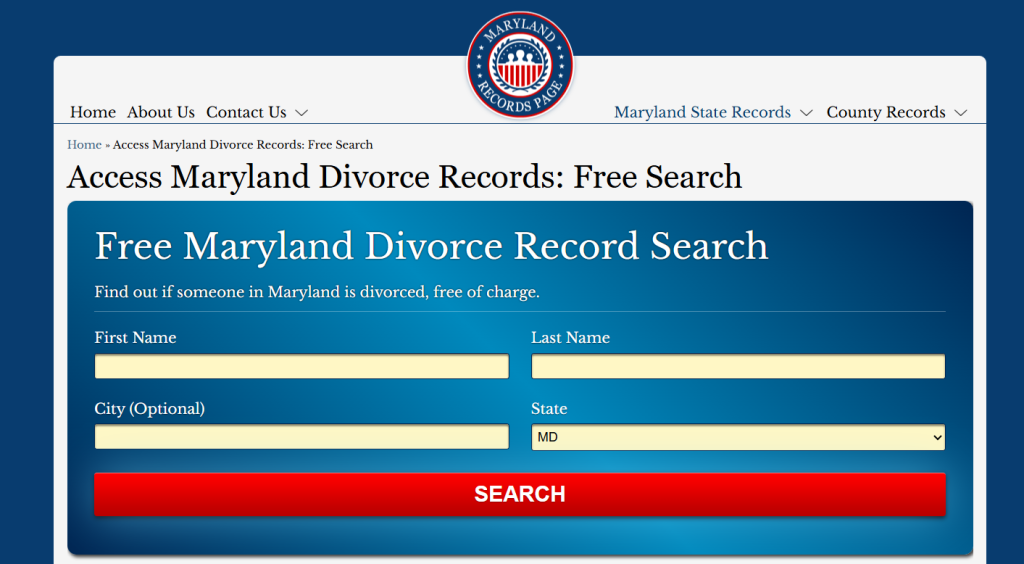
Use Maryland Judiciary Case Search
Maryland Judiciary Case Search provides public access to case information from Maryland District and Circuit Courts, subject to the state’s rules governing access to court records.
For a divorce search, start with the names of the people involved in the case.
You may also be able to narrow the search using information such as:
- County
- Court system
- Case type
- Filing date
- Party name
- Case number
Maryland’s Case Search system uses exact-name searches by default. For partial-name searches, the Judiciary provides a specific format using the first character of the last name followed by a percent sign.
Review the case information
Once you find a possible match, check the information carefully. Look for:
- Names of the parties
- Case number
- Court
- County
- Filing information
- Case status
- Disposition or other available case information
The case number is particularly useful if you later need to request documents from the Circuit Court.
Maryland Courts specifically recommends using Case Search to find the case number when looking for a judgment of divorce. If an online search does not locate the case, the appropriate Circuit Court clerk may also be able to help identify the case number.
How to Get a Copy of a Divorce Decree
Finding a divorce case online and obtaining the actual decree are two different steps.
Contact the Circuit Court
The actual Decree of Divorce and Annulment of Marriage must be obtained from the Circuit Court that granted the decree. The Maryland Department of Health does not issue copies of these court documents.
Maryland Courts advises people seeking a judgment of divorce to identify the case number first and then contact or visit the Circuit Court where the divorce was granted. Copies of divorce decrees and other documents in the case file are not generally available through the online case-search system.
You should have as much of the following information as possible:
- Full names of both spouses
- Approximate divorce date or year
- County where the divorce occurred
- Case number, if known
- Type of copy requested
- Contact information
- Identification or other documentation if required by the court
Individual clerks’ offices may have their own request forms, payment procedures, and copy charges. Those details should be confirmed with the Circuit Court handling the record rather than assumed to be the same statewide.
For example, Baltimore County provides a specific request process for divorce decrees, while Cecil County has its own form and fee structure. These county examples demonstrate why users should verify the requirements with the appropriate Circuit Court.
How Maryland Divorce Verification Works
A divorce verification is useful when you need official confirmation that a divorce or annulment occurred but do not necessarily need the complete court decree.
What the verification contains
The Maryland Department of Health’s Division of Vital Records provides divorce verifications for divorces and annulments occurring on or after January 1, 1992. The verification can include:
- Names of the divorced individuals
- County where the divorce occurred
- Date of the decree
- Type of divorce action
The Department of Health states that a verification is different from a copy of the actual decree. The decree must be requested from the Circuit Court that granted it.
Who can request a verification?
The Maryland Department of Health identifies the following applicants:
- Either spouse named on the record
- An authorized representative of either spouse
- An attorney representing either spouse
A representative must provide documentation showing permission from the spouse named on the record. An attorney must provide proof of representation.
The current Maryland Department of Health fee schedule lists the fee for a divorce verification as $12, with additional charges applying to certain online or expedited services.
Divorce Records and Public Access in Maryland
Not every document associated with a divorce is freely available to anyone who asks.
Maryland Courts generally states that court records are open to public inspection subject to exceptions, including records that are sealed, shielded, or otherwise protected by law or court order.
New access rules took effect in October 2026
Maryland’s rules regarding divorce records changed on October 1, 2026, following the enactment of Senate Bill 426, the Public Information Act – Divorce Records law.
The legislation requires custodians to deny inspection of certain records relating to divorce proceedings, subject to specified exceptions. The Maryland General Assembly lists the law as Chapter 880, with an effective date of October 1, 2026.
The Maryland State Archives now notes that, with the new rules, divorce case materials are restricted except for the final divorce decree, with access to other case materials generally limited to persons of interest, their legal representatives, or other authorized circumstances.
This distinction matters when performing a divorce records search. Finding a case does not mean that every document filed in that case can be viewed or copied by the public.
What Can You Find Online?
Online access depends on the type and age of the record.
Case information
Maryland Judiciary Case Search can provide selected information from qualifying court records. It is not a substitute for the complete court file. Maryland Courts specifically explains that remote access through Case Search provides selected information rather than the entire judicial record.
Older divorce records
Historical divorce records may be available through the Maryland State Archives. The Archives maintains indexes and records for divorce and other equity proceedings from different counties and time periods.
Availability varies by county, record series, and date. Some older records may have been transferred to the Archives, while others may remain with the relevant court.
The Archives also provides a process for requesting certain divorce decrees. Its published information states that divorce decrees are available only for county Circuit Courts that have transferred the applicable case files to the Archives.
What Information Do You Need?
A search is much easier when you have accurate identifying information.
Try to gather:
- Full legal name of either spouse
- Full name of the other spouse
- Approximate year of divorce
- Maryland county where the case was filed
- Approximate filing or decree date
- Case number, if available
If a name is common, the county and approximate year can make a significant difference.
If the person changed their name after the divorce, try searching under the name used during the court proceeding. A different spelling, middle name, or maiden name can also affect search results.
What If You Cannot Find the Record?
A missing result does not necessarily mean that no divorce occurred.
Check the county
Divorce cases are handled through Maryland Circuit Courts. If you know where the divorce was granted, check that county’s Circuit Court records office.
If you do not know the county, use any available information about where the spouses lived or where the case was filed to narrow the search.
Check name variations
Try alternative spellings and names that may have been used during the case. For older records, indexing practices can also differ from modern online searches.
Search by case number
If you have a case number from an older document, court correspondence, or previous search, use it whenever the system permits. A case number can be more precise than a name alone.
Contact the clerk
If the online system does not provide what you need, contact the Clerk of the Circuit Court where the divorce was granted. Maryland Courts identifies local clerks’ offices as the primary custodians for many judicial records.
Common Maryland Divorce Records Search Mistakes
Several mistakes can make a records search unnecessarily difficult.
Searching only by current name
A person may have used a different surname during the divorce. Searching only a current name may not produce the expected result.
Expecting the full decree online
Case Search is useful for locating case information, but it does not provide a complete copy of every court record. The actual divorce decree generally comes from the Circuit Court that granted the divorce.
Confusing verification with a decree
A Maryland divorce verification confirms key details about a divorce, but it is not the same as the court’s judgment.
If an agency specifically asks for the divorce decree, request the document from the Circuit Court rather than ordering only a verification.
Assuming all records are public
Access rules apply to divorce case materials, and Maryland’s new restrictions effective October 1, 2026, make the distinction especially important. Certain documents may be restricted even when basic case information or the final decree is accessible.
Using outdated fees or procedures
Copy charges and request methods can differ between Circuit Courts. Always check the current instructions from the clerk responsible for the record.
Maryland Divorce Records: State vs. County Responsibilities
Different agencies handle different parts of the records process.
| Need | Where to start |
|---|---|
| Search basic court case information | Maryland Judiciary Case Search |
| Find a case number | Maryland Judiciary Case Search or Circuit Court clerk |
| Obtain a divorce decree | Circuit Court that granted the divorce |
| Obtain divorce verification | Maryland Department of Health, Division of Vital Records |
| Research older historical records | Maryland State Archives |
| Request documents from a local case file | Appropriate Circuit Court Clerk’s Office |
This division of responsibilities is important because there is no single Maryland website that provides every divorce document for every period.
The Maryland Judiciary provides statewide court-search resources, while local Circuit Courts maintain many case records. The Maryland Department of Health handles divorce verification, and the Maryland State Archives preserves eligible historical government records.
Is Maryland Divorce Information Free?
Some online case information may be searched through Maryland Judiciary resources without paying for a copy of a record. However, obtaining physical, certified, or other copies can involve fees.
The cost depends on the record requested and, in some situations, the county Circuit Court. For example, county clerk offices publish their own copy and certification charges.
The Maryland Department of Health separately lists a $12 divorce verification fee, before any applicable online processing or expedited shipping charges.
Because fees can change, verify the amount with the agency handling your specific request.
Frequently Asked Questions
Can I search Maryland divorce records online?
You can search available Maryland court case information online through the Maryland Judiciary’s Case Search system. However, online case information is not the same as the complete divorce file or a copy of the divorce decree.
How do I find out if someone is divorced in Maryland?
Start with Maryland Judiciary Case Search using the person’s name and, when possible, the county and approximate date. You can also request a divorce verification from the Maryland Department of Health when the record qualifies and you meet the eligibility requirements.
Can I get a Maryland divorce decree online?
The Maryland Judiciary explains that copies of divorce decrees and other case documents are not generally available through Case Search. You normally need to obtain the decree from the Circuit Court that granted the divorce.
How far back do Maryland divorce records go?
Historical divorce materials exist for many periods and counties. The Maryland State Archives maintains records and indexes covering different historical periods, but availability varies by county and record series.
What is the difference between a divorce decree and divorce verification?
A divorce decree is the court’s final judgment ending the marriage and may address other legal issues. A divorce verification is issued by the Maryland Department of Health and confirms selected details about a qualifying divorce or annulment.
Can anyone view the entire Maryland divorce case?
No. Public access does not mean every document is available to everyone. Maryland’s divorce-record access rules were changed effective October 1, 2026, and certain divorce-related records are now subject to additional restrictions.
Is this website an official Maryland government website?
No. This website is a private informational platform and is not operated by Maryland.gov, the Maryland Judiciary, the Maryland Department of Health, the Maryland State Archives, or a Maryland county government. For official records, copies, fees, and current access requirements, verify information directly with the appropriate government agency.