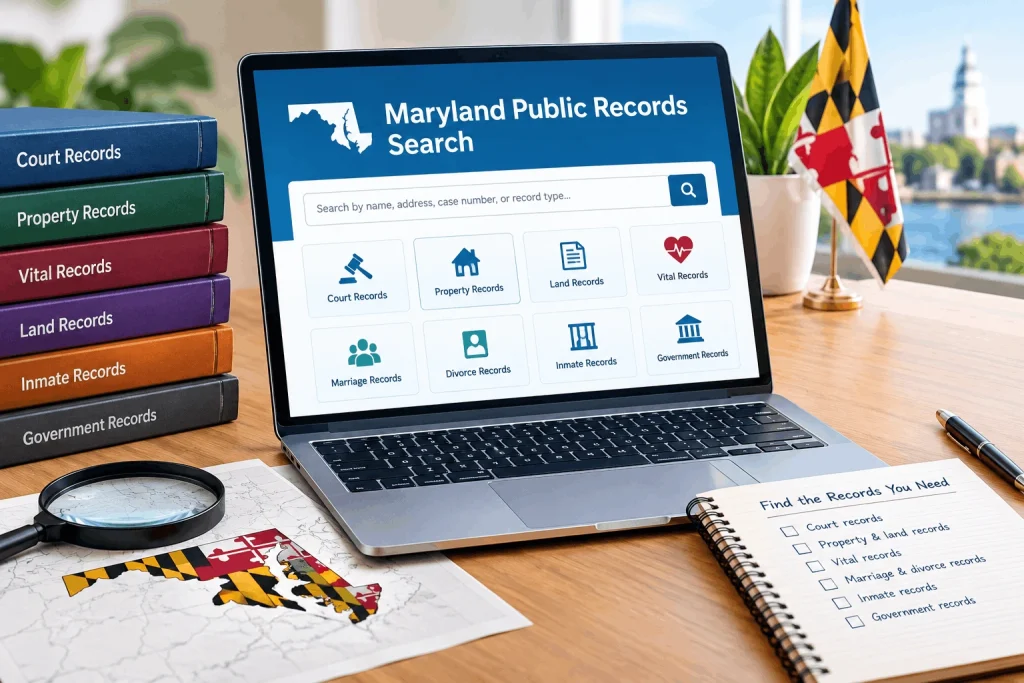
Maryland public records are maintained by different state, county, and local agencies, so there is no single database containing every record. The right search method depends on what you need to find. Court cases are handled through the Maryland Judiciary, property information is available through the Maryland Department of Assessments and Taxation (SDAT), vital records are issued through the Maryland Department of Health, and older historical records are often held by the Maryland State Archives.
A useful search starts by identifying the type of record and the agency responsible for it. This can save time and help you avoid relying on unofficial websites that may contain incomplete or outdated information.
What Are Maryland Public Records?
Maryland public records are documents and information created or received by government agencies in connection with public business. Maryland’s Public Information Act, commonly called the PIA, gives the public a broad right to inspect and obtain copies of disclosable government records while also recognizing exemptions that protect privacy and other legitimate government interests.
The term covers many different types of information.
Common Types of Records
Depending on the agency, a Maryland public records search may involve:
- Court case records
- Land records and deeds
- Property assessment information
- Marriage records
- Birth and death records
- Divorce verification records
- Inmate and incarceration information
- Business records
- Government documents
- Historical and archival records
- Certain licensing and regulatory records
Not every record is publicly available in the same way. Some records are restricted by law, sealed by a court, shielded, or available only to people who meet specific requirements.
Where to Search Maryland Public Records
The most important step is choosing the correct government system. Maryland separates records among specialized agencies rather than placing everything into one statewide search tool.
| Record Type | Primary Official Source | What You May Find |
|---|---|---|
| Court cases | Maryland Judiciary Case Search | Case information and selected case details |
| Land records | Maryland Land Records / Circuit Courts | Deeds, mortgages, liens and other land documents |
| Property records | Maryland SDAT | Property ownership, assessment and sales information |
| Birth records | Maryland Department of Health | Eligible birth certificates |
| Death records | Maryland Department of Health | Eligible death certificates |
| Marriage records | Maryland Department of Health / local or historical sources | Marriage certificates and older records |
| Divorce verification | Maryland Department of Health | Divorce or annulment verification |
| Incarceration records | Maryland DPSCS | Incarcerated individual locator information |
| Government records | Maryland PIA process | Records held by government agencies |
| Historical records | Maryland State Archives | Older government, court, land, probate and vital records |
The Maryland State Archives also maintains a Guide to Government Records that can help researchers identify records by agency, record series, jurisdiction, and record type.
How to Search Maryland Court Records
Court records are among the most frequently searched public records in Maryland. The Maryland Judiciary provides public access through its Case Search system.
Use Maryland Judiciary Case Search
Maryland Judiciary Case Search
Case Search provides public access to case information from Maryland state courts, including District Court and Circuit Court records. The information available online is a summary rather than a complete copy of the court file.
A typical search can involve:
- Open the Maryland Judiciary Case Search system.
- Enter the person’s name or other available search information.
- Review matching cases.
- Check the case number, court, filing information and case status.
- Review available case details.
- Contact the appropriate clerk’s office if you need documents from the complete file.
Search Names Carefully
Maryland Case Search uses exact-name searching by default. For a partial last-name search, the Judiciary instructs users to enter at least the first character of the last name followed by a percent sign.
This matters when a search produces no results. A spelling difference, name change, or incomplete information can affect what appears.
Online Results Are Not the Complete File
A common mistake is treating a Case Search result as a complete court record. The Judiciary explains that Case Search provides selected information from a case, while the complete file may need to be reviewed through the clerk’s office.
Some records are also unavailable to the general public. Examples include certain juvenile matters, adoption records, sealed or shielded records, and other categories protected by law or court order.
How to Search Maryland Property Records
Property information is maintained separately from court case records. For statewide real property information, the primary source is the Maryland Department of Assessments and Taxation.
Use the SDAT Property Search
Maryland SDAT Real Property Search
SDAT’s Real Property Data Search provides property assessment and sales information for Maryland properties. The state says its public real property data can be accessed through the online search system.
Depending on the property and search method, the database can help you research information associated with a parcel.
Search by Address or Account Information
SDAT provides specific instructions for finding property information. Searches can be performed using an address, street name, account identifier, or map reference. The system does not allow a general search by owner’s name, town, neighborhood, or ZIP code.
If an address search fails, check the way the street name is entered. SDAT advises users not to include street-direction terms or street-name suffixes when using its address search format.
Property Records vs. Land Records
These two record types are related but not identical.
SDAT is useful for property assessment and sales information. Land records, on the other hand, contain recorded documents such as deeds and mortgages.
For recorded land documents, the Maryland Judiciary directs users to Maryland Land Records, a service provided by the Judiciary and Maryland State Archives.
This distinction is important when someone wants to verify a property’s recorded deed rather than simply review assessment information.
How to Find Maryland Land Records
Maryland land records can contain deeds, mortgages, releases, plats, surveys and other documents connected with real property.
Search the Maryland Land Records System
The Maryland State Archives identifies Maryland Land Records as a digital repository for land records created and verified by the clerks of the Circuit Courts.
The Archives explains that land records have been recorded throughout Maryland’s history and that many records can be accessed online. If you need a legally certified copy, the Archives recommends placing a paid order rather than treating an online image as a certified document.
When You Need a Deed
If your goal is to determine how a property was transferred, look for the land record rather than relying only on an assessment database.
A deed may help establish:
- Grantor and grantee information
- Transfer details
- Recorded document information
- Property description
- Related land-record references
For legal transactions, title work, or a document that must be formally accepted, confirm the requirements with the appropriate court, recorder, title professional, or government office.
How to Search Maryland Marriage Records
Marriage records are handled differently depending on the date of the marriage and the type of document requested.
Recent Marriage Certificates
The Maryland Department of Health’s Division of Vital Records issues certified copies of marriage certificates for marriages that occurred in Maryland on or after January 1, 2007.
Eligibility restrictions apply to obtaining certified copies. The state identifies the people who may apply and provides instructions for authorized representatives.
For marriages before 2007, the Maryland Department of Health directs users to the Circuit Court in the county where the marriage occurred or the Maryland State Archives.
This date distinction is important because searching the wrong agency can lead to a record appearing to be unavailable when it is actually held elsewhere.
How to Find Maryland Birth and Death Records
Birth and death certificates are considered vital records, but access is subject to eligibility requirements and record-specific rules.
Birth Records
The Maryland Department of Health’s Division of Vital Records provides birth certificates for eligible applicants. The department also works with certain local health departments that provide certificate services.
Death Records
The Division of Vital Records issues certified copies of death certificates for deaths occurring in Maryland in 2012 or later. For deaths before 2012, the department directs researchers to the Maryland State Archives.
This illustrates why a general internet search may not be enough. Older records may have moved into archival collections, while newer certificates remain with the Department of Health.
Certified Copies and Search Results
A person researching a historical event may only need an index or record reference. Someone applying for a legal, governmental, or administrative purpose may need a certified copy.
Those are different needs, so determine the purpose of the record before ordering anything.
How to Find Maryland Divorce Records
Divorce information can come from more than one source depending on what you need.
Divorce Verification
The Maryland Department of Health provides divorce verifications for divorces and annulments that occurred on or after January 1, 1992. The verification can include the names of the people involved, county, date of decree, and type of action.
Actual Divorce Decree
A divorce verification is not the same as the complete divorce decree. The Maryland Department of Health states that a copy of the actual decree must be obtained from the Circuit Court that granted the divorce.
That distinction can prevent unnecessary delays when someone needs the full court document rather than confirmation that a divorce occurred.
How to Search Maryland Incarceration Records
For information about a person currently in Maryland’s correctional system, use the official Maryland Department of Public Safety and Correctional Services rather than an unrelated commercial database.
Maryland DPSCS Incarcerated Individual Locator
The department provides an online incarcerated individual locator among its public services.
Searchers should distinguish incarceration information from court information. A court case may show charges or case outcomes, while a correctional locator serves a different purpose and may provide information about custody or incarceration.
How to Request Government Records Under the PIA
Not every government record has an online search form. When an agency maintains a record that is not available through a public database, Maryland’s Public Information Act provides a process for requesting access.
Identify the Records Custodian
The Maryland Attorney General explains that requesters should identify the appropriate records custodian for the state, county, or municipal agency that holds the record and submit the request to that contact.
Make the Request Specific
A useful request should identify the records as clearly as possible.
Include details such as:
- Agency or department
- Type of record
- Relevant names
- Property address, case number, or account number when applicable
- Date range
- Preferred format, if relevant
- Contact information for follow-up
The PIA gives the public access to disclosable government records, but it does not require an agency to create a new record simply to answer a question.
Records May Be Exempt
Public access does not mean every government document is unrestricted. Maryland law contains exemptions and protections involving privacy, confidential information, law-enforcement interests, and other categories.
If an agency denies access, the Maryland Attorney General’s PIA resources explain options available to requesters, including the Public Access Ombudsman process for certain disputes.
How to Search Older Maryland Records
Historical research often requires a different strategy from searching recent records.
Use the Maryland State Archives
The Maryland State Archives is the central repository for state government records of permanent value. Its collections include state, county and municipal records, and its Guide to Government Records allows users to search by record series, agency and record type.
The Archives specifically warns that it does not have one database containing every collection. Researchers should first identify what information they need and then determine which record series is relevant.
This is especially useful for genealogy, historical property research, probate research, and older vital records.
Tips for a More Accurate Records Search
A few simple steps can make a Maryland public records search much more effective.
Start With the Record Type
Do not begin with a broad search for a person’s name unless you know what information you are trying to locate.
Instead, decide whether you need:
- A court case
- Property assessment information
- A deed
- A marriage certificate
- A death certificate
- A divorce verification
- An incarceration record
- A government document
- A historical record
This immediately narrows the appropriate source.
Collect Identifying Information
The more accurate information you have, the easier it is to distinguish between people with similar names.
Useful details can include:
- Full legal name
- Previous name
- Date of birth
- County
- Approximate date
- Property address
- Case number
- Property account number
Do not assume that a matching name alone proves that a record belongs to the person you are researching.
Check the Original Agency
Third-party record websites can sometimes be useful for discovering leads, but the government agency is the better source when accuracy, current status, or an official copy matters.
For example, Maryland Courts specifically warns that Case Search information is informational and not an authoritative legal document.
Know When You Need a Certified Copy
An online record image, database entry, verification, and certified copy are not necessarily interchangeable.
If the document will be submitted to a court, government agency, employer, financial institution, or another organization, check what form of documentation is required before ordering.
Common Mistakes to Avoid
Searching Maryland public records can become difficult when the wrong system is used.
Searching Everything in One Place
There is no single official Maryland search box for every type of public record. The Judiciary, SDAT, Department of Health, DPSCS, State Archives, and individual agencies have different responsibilities.
Assuming Every Record Is Public
Some records are sealed, shielded, confidential, restricted, or available only to eligible applicants. Court records, for example, have several categories that are not generally open to public inspection.
Confusing Property and Land Records
An SDAT property search is not a replacement for a recorded deed search. Assessment information and land-record documents serve different purposes.
Using Outdated Instructions
Government systems can change. Maryland’s Judiciary introduced a new Case Search and Record Portal in 2026, and SDAT has also updated its real property search system and security procedures.
For that reason, use current official Maryland websites when beginning a search.
Frequently Asked Questions
Is there one Maryland public records database?
No. Maryland public records are distributed among different agencies and systems. The appropriate database depends on the record type. Court cases, property information, vital records, land records, incarceration information, and agency records are handled through different official sources.
Can I search Maryland court records online?
Yes. The Maryland Judiciary provides online access to public case information through Case Search. However, online results are generally a summary and may not contain the complete court file.
Can I search Maryland property records by owner’s name?
The statewide SDAT property search does not provide a general owner-name search. SDAT’s instructions identify address, street name, account identifier, and map reference as available search methods.
Are Maryland marriage records public?
Access depends on the record, date, and type of copy requested. The Maryland Department of Health issues certified marriage certificates for eligible applicants for marriages occurring on or after January 1, 2007. Older marriage records may require contacting the relevant Circuit Court or Maryland State Archives.
How can I find an old Maryland public record?
Start with the Maryland State Archives and its Guide to Government Records. The Archives maintains historical state, county, and municipal records, but not every record is digitized or available online.
Can I request a Maryland government record that is not online?
Yes. Maryland’s Public Information Act provides a process for requesting access to disclosable records held by state and local government agencies. The request should be directed to the appropriate records custodian.
Are online Maryland public records always official copies?
No. An online database result may provide useful information without being a certified legal document. For example, Maryland Judiciary states that Case Search information is not intended to serve as an authoritative public record or legal document.
Final Steps for a Maryland Records Search
The fastest way to find a Maryland public record is to match the record with the agency that maintains it. Use Maryland Judiciary Case Search for court information, SDAT for statewide property assessment data, Maryland Land Records for recorded property documents, the Department of Health for eligible vital records, DPSCS for incarceration information, and the Maryland State Archives for many historical records.
When a record is not available through an online database, the Maryland Public Information Act may provide another route for requesting government records. Always verify important information through the agency responsible for the original record, especially when you need a certified copy or documentation for an official purpose.