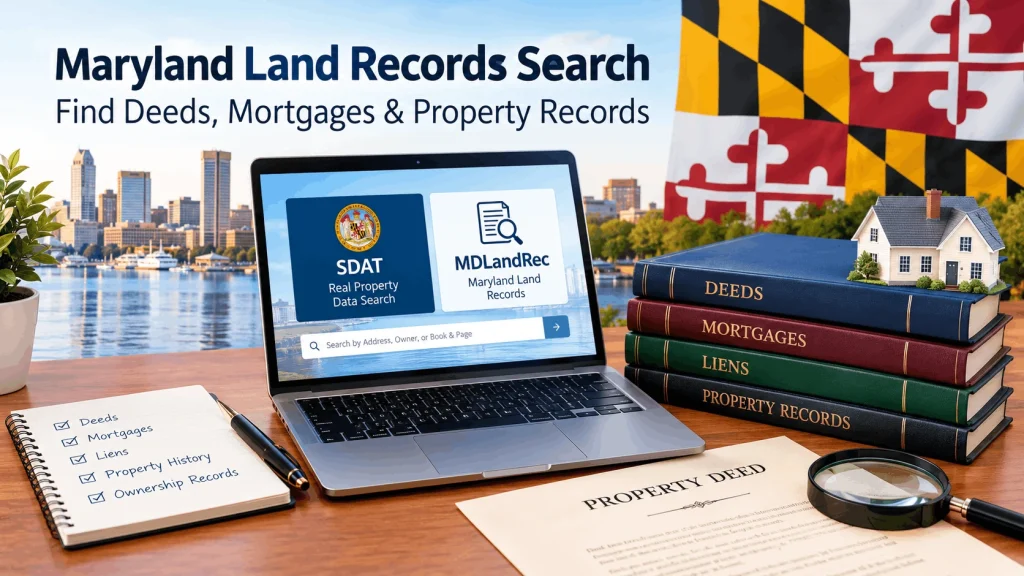
A Maryland land records search can help you locate deeds, mortgages, liens, leases, releases, and other documents affecting real property. These records are maintained through the land records departments of Maryland’s Circuit Courts and are available through the state’s online systems and local court offices.
The main challenge is knowing which system to use for the information you have. Maryland’s Department of Assessments and Taxation (SDAT) is useful for finding a property by address and obtaining its deed reference. MDLandRec, operated by the Maryland State Archives with the Maryland Judiciary, is where users can view recorded land record documents and historical indexes.
This guide explains how the two systems work together, what information land records contain, how to trace earlier deeds, and what to do when an online search does not produce the record you need.
What Are Maryland Land Records?
Maryland land records are official records concerning legal interests in real property. Each of Maryland’s 23 counties and Baltimore City has a Department of Land Records located within the Circuit Court Clerk’s Office.
Documents Found in Land Records
Depending on the county and record series, you may encounter:
- Deeds
- Mortgages and deeds of trust
- Releases of mortgages or deeds of trust
- Leases
- Land contracts
- Liens
- Powers of attorney
- Easements and other instruments affecting property interests
- Certain historical records
- Related land record indexes
Maryland’s land-record system also contains historical material. The Maryland State Archives notes that the collection extends from modern records back to the earliest surviving land records for each county.
What a Deed Tells You
A deed documents a transfer of ownership rights from a grantor to a grantee. Depending on the document, it can provide information about the parties, property description, consideration, prior deed references, and other terms connected with the transfer.
A deed is therefore different from a basic property assessment record. The deed is a recorded legal instrument, while an SDAT property record provides assessment and property information. Understanding this distinction makes a property records search much easier.
Maryland Land Records vs. SDAT Property Records
One of the most important parts of a Maryland land records search is knowing which database to start with.
| Resource | Best used for | Typical information |
|---|---|---|
| SDAT Real Property Data Search | Finding a property | Address, owner information, account identifier, assessment information, deed reference |
| MDLandRec | Viewing recorded documents | Deeds, mortgages, liens and other land instruments |
| Circuit Court Clerk’s Office | In-person assistance and records | Land records, copies and local record services |
| Plats system | Finding recorded plats | Subdivision, condominium and survey-related plat information |
| Maryland Case Search | Court cases and judgments | Court case information, including matters that may affect property |
Maryland Courts specifically distinguishes these systems. SDAT provides property ownership and value information, while MDLandRec provides online access to Maryland land record documents.
Why SDAT Is Often the Best Starting Point
For most counties, MDLandRec does not begin with a simple statewide address search. Maryland State Archives directs users to SDAT when they need to find a property’s deed reference from an address.
That makes the process easier:
Property address → SDAT record → deed reference → MDLandRec document
This is particularly useful when you do not already know the property’s current deed book and page.
How to Search Maryland Land Records Online
The easiest approach depends on what information you already have.
Step 1: Find the Property in SDAT
Open the Maryland Department of Assessments and Taxation’s Real Property Data Search and select the appropriate county. SDAT allows searches using information such as a street address, account identifier, or map reference.
The system does not provide a general owner-name search for its property database. If you are starting with an address, use the address search instead.
Step 2: Enter the Address Carefully
SDAT provides specific instructions for address searches.
For example, its guidance says not to include street directions or street-name suffixes when performing the standard address search. If a precise street search does not produce the expected property, SDAT recommends using its broader search techniques.
If you cannot find the property, check:
- Whether the correct county was selected
- The spelling of the street name
- Whether the street direction was omitted
- Whether the street suffix was omitted
- Whether you have the correct property address
Step 3: Locate the Deed Reference
Once you find the correct property, review its property information for the deed reference.
A deed reference normally appears as a book/page combination. For example, a reference such as 6535/240 means book 6535, page 240. Maryland State Archives explains that this information can be transferred into MDLandRec to locate the corresponding land record.
Step 4: Open MDLandRec
Go to Maryland Land Records through the Maryland State Archives. The current system is MDLandRec, available through the Maryland State Archives website.
The Archives launched an updated version of the system in November 2025. Users need to create a new login for the updated website, and the system uses additional account security features.
Once logged in, select the appropriate county and use the available search fields.
Step 5: Search by Book and Page
If SDAT gave you a deed reference, a book-and-page search is usually one of the most direct ways to reach the document.
MDLandRec’s updated system allows users to search for an instrument by book/page and also provides a way to jump directly to a specific book and page.
After opening the record, you can review the scanned document to verify the names, property description, dates, and references to earlier records.
How to Search by Owner or Party Name
Searching by name is particularly useful when you are researching a property history, historical ownership, or a document for which you already know one of the parties.
Use Grantor and Grantee Information
Land records generally involve two important party roles:
- Grantor: The party transferring an interest
- Grantee: The party receiving an interest
The exact search approach can vary depending on the county, record period, and index.
MDLandRec’s current search system provides several search modifiers, including Begins With, Ends With, Contains, Fuzzy, and Soundex options for certain fields. These features can help when a name may have been entered differently in different records.
Start Broad When a Name Fails
A common mistake is entering every detail you know and expecting an exact match.
Historical land indexes can contain:
- Misspellings
- Missing middle names
- Different suffixes
- Maiden names
- Abbreviated names
- Older spelling conventions
The Maryland State Archives recommends starting broadly and narrowing the search when necessary.
If an exact name does not work, try fewer identifying details or an appropriate partial-name search.
How to Trace a Property’s Ownership History
Finding the current deed is often only the first part of a land records search. If you want to understand how ownership changed over time, you can work backward through earlier deeds.
Start With the Current Deed
First, locate the current deed through SDAT and MDLandRec. Read the document carefully rather than relying only on the index.
A current deed often contains a reference to the previous deed. Maryland State Archives explains that this may appear in language similar to “being the same as” followed by a book and page reference.
Follow the Previous Reference
Use the earlier book and page number to locate the prior deed in MDLandRec.
That earlier deed may contain another reference to an even older transaction. Continue following those references to build a chain of ownership.
If the prior deed reference is missing, Maryland Archives recommends using the grantee indexes and searching with the name of the grantor from the current deed.
Why Chain of Title Matters
A chain of title shows how interests in a property moved from one party to another over time.
It can help researchers understand:
- Previous owners
- Earlier transfers
- Older deed references
- Changes in property descriptions
- Historical ownership patterns
However, researching a chain of title yourself is not the same as receiving a professional title search. Maryland court clerks specifically state that they do not perform title searches or provide legal advice.
What About Liens and Mortgages?
Land records can contain documents affecting financial interests in real property, including mortgages and certain liens.
Mortgage Records
A mortgage or deed of trust may appear in the land records after a property purchase or refinancing transaction. A later release can indicate that a recorded mortgage or deed of trust has been released.
Do not assume that seeing one document provides a complete picture of every obligation associated with a property.
Property Liens
Maryland Courts warns that finding all liens can be difficult because different types of liens may be recorded in different places. Some property-related liens are recorded with land records, while court judgments and unpaid tax obligations may require other searches.
For example:
- Land-record liens can be searched through MDLandRec.
- Court judgments may require Maryland Case Search.
- Unpaid property taxes or municipal charges may require checking the relevant local finance or tax office.
This distinction is important if your purpose is due diligence before purchasing or transferring property.
Are Maryland Land Records Public?
Generally, deeds and other recorded land documents are public records. Maryland Courts states that members of the public can view and obtain copies of deeds. Online viewing is available through MDLandRec, while many courthouses also provide public computer terminals.
The fact that a record is public does not mean every related property issue will appear in the same database. Different government systems serve different purposes.
For example, a property assessment record, recorded deed, court judgment, tax balance, and foreclosure case may be maintained in separate systems.
How Much Does It Cost to View a Deed?
Online viewing of deeds through MDLandRec is available without a viewing fee after account registration. Maryland Courts states that copies of land-record documents cost $0.50 per page.
Fees can differ for other services, such as certified copies or recording a new document. Because recording fees and local procedures can change, check the relevant Circuit Court Clerk before submitting documents or requesting specialized services.
If you only need to read a deed, purchasing an expensive third-party property report may be unnecessary. Maryland’s official online systems may provide the underlying record directly.
When You Cannot Find a Record Online
An unsuccessful search does not necessarily mean that no record exists.
Check the Search Details
Before assuming the record is missing, verify:
- The correct county or Baltimore City was selected.
- The property address is correct.
- The SDAT account is the right parcel.
- The book and page were entered correctly.
- The party name was entered using a reasonable search variation.
- You are searching the correct historical index or record series.
MDLandRec’s search documentation specifically notes that historical data can contain inconsistent names and missing information.
Consider Historical Records
Maryland’s land records collection includes records extending far into the past. Some research therefore requires working with historical indexes and older terminology rather than modern property addresses.
The Maryland State Archives provides guides for historical land-record research and notes that its online collection extends to the earliest surviving land records for each county.
Contact the Appropriate Office
If you still cannot locate a document, the Department of Land Records in the relevant Circuit Court can be another resource.
Clerks may be able to help locate a deed when you have a reference number or need assistance identifying a record. However, they cannot perform a title search or provide legal advice.
Maryland Land Records Search for Baltimore City
Baltimore City deserves special attention because its property-record workflow differs from most Maryland counties.
MDLandRec’s guidance states that its system supports block-number or street-address searching for Baltimore City. For other Maryland counties, users are directed to the SDAT Real Property Data Search when starting with an address.
If you are researching Baltimore City property, therefore, the starting point may be different from a property located in Montgomery, Prince George’s, Anne Arundel, Howard, Baltimore County, or another Maryland jurisdiction.
Land Records vs. Property Tax Records
A land record should not be confused with a property tax record.
Land records focus on recorded legal instruments affecting interests in real estate.
SDAT property records provide property assessment and ownership-related information used within Maryland’s property assessment system. The state describes its Real Property Data Search as a system for displaying property records and notes that the information is provided for informational purposes rather than as a legal report.
For a complete property investigation, you may need both.
A practical workflow is:
SDAT → identify the property → obtain deed reference → MDLandRec → review the recorded instrument → check other relevant systems if necessary.
Common Mistakes to Avoid
A few errors can make an otherwise straightforward search much harder.
Searching Only by Address
An address may help you locate the current property record, but it may not be enough for historical research. Older deeds may use different descriptions, parcel references, or historical owners.
Treating SDAT as the Deed Database
SDAT can provide a deed reference, but the actual recorded deed image is accessed through Maryland Land Records.
Assuming One Database Contains Everything
Land records, tax information, court cases, plats, and assessment information can be distributed across different systems.
Assuming an Online Search Is a Title Search
A self-service search can help you research documents, but it should not be treated as a professional title examination. Maryland Courts explicitly says its clerks do not perform title searches.
Frequently Asked Questions
How do I search Maryland land records by address?
For most Maryland counties, begin with the SDAT Real Property Data Search. Find the property by address and look for its deed reference. You can then use the book and page information in MDLandRec to locate the recorded deed.
Is Maryland Land Records free?
Viewing land-record images online through MDLandRec is available free of charge after creating an account. Copies requested through a clerk’s office may have applicable fees; Maryland Courts lists $0.50 per page for copies.
Can I find a Maryland deed online?
Yes. Maryland Courts states that deeds can be viewed online through MDLandRec. The Maryland State Archives maintains the digital repository in partnership with the Maryland Judiciary.
Can I search Maryland property records by owner’s name?
The SDAT Real Property Data Search does not provide a general owner-name search. For many land-record searches involving a person’s name, MDLandRec and its grantor/grantee indexes are more appropriate.
How do I find the deed reference for a Maryland property?
Search for the property in SDAT using its address or another supported search method. The property record can provide a book/page deed reference, which can then be entered into MDLandRec.
Can I trace an older owner of a Maryland property?
Yes. After finding the current deed, look for the reference to the previous deed, often introduced by wording similar to “being the same as.” Use that earlier book and page reference to continue working backward through the chain of title.
Where can I find property plats?
Maryland’s land-record resources include a separate digital plat system. Maryland Courts identifies Plats.net as the system for land survey, subdivision, and condominium plats.
Does a land records search show every lien on a property?
Not necessarily. Maryland Courts cautions that different liens can be recorded in different places. Court judgments may require a Maryland Case Search, while unpaid taxes or municipal liens may require checking the appropriate local office.
Can the Circuit Court Clerk perform a title search for me?
No. Maryland Courts states that land-record clerks cannot perform title searches or provide legal advice. If you need a formal title examination, consider consulting a qualified Maryland attorney or title professional.
Final Takeaway
A Maryland land records search is easiest when you use the state’s systems for their intended purposes. SDAT is generally the starting point when you have a property address, while MDLandRec is the key resource for viewing recorded deeds and other land instruments.
For basic research, you can usually follow a simple path: identify the parcel, obtain its deed reference, open the recorded document, and follow earlier deed references when you need to research ownership history.
When the purpose involves a purchase, title examination, unresolved liens, foreclosure, or another legal matter, remember that a public-record search is not the same as a professional title search. Use the appropriate Maryland agency or qualified professional when the stakes require a complete legal review.