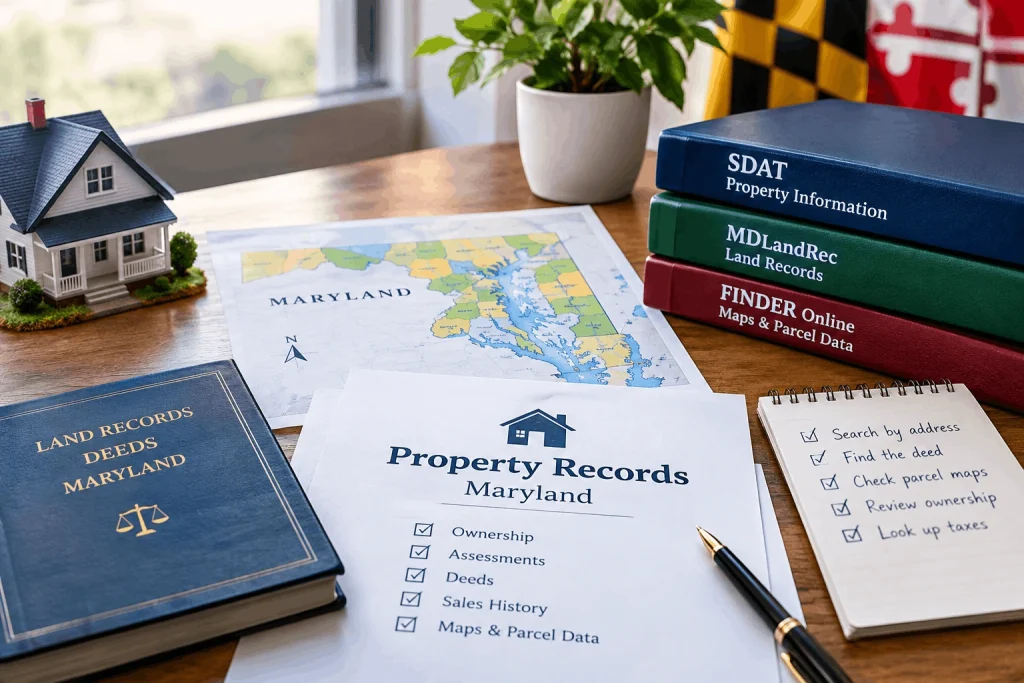
A Maryland property records search can help you identify a property, review its assessment information, find a recorded deed, check recent sales, and locate parcel or tax-map information. The key is knowing which Maryland agency maintains the type of record you need.
For most property lookups, the best starting point is the Maryland Department of Assessments and Taxation (SDAT) Real Property Data Search. SDAT provides statewide access to property ownership and valuation information and records sales information for real property accounts.
However, SDAT is not the only source. Deeds, mortgages, liens, and other documents affecting ownership are maintained through the land records departments of Maryland’s Circuit Courts and can be researched through MDLandRec. Maryland’s FINDER Online is useful when you need parcel boundaries, tax maps, property sales, or other geographic information.
What Are Maryland Property Records?
Maryland property records are public information associated with real estate located within the state. They are not all stored in one identical record system.
Different agencies maintain different parts of a property’s history. SDAT maintains assessment and property-account information, while county Circuit Court land records preserve legally recorded instruments such as deeds and mortgages.
Common Information You Can Find
Depending on the record and source, a search may reveal:
- Property address
- Owner information
- Mailing address
- Property account identifier
- Legal description
- Parcel, map, and grid information
- Property classification or use
- Land area
- Building characteristics
- Assessment information
- Recorded sales
- Deed reference
- Mortgage or deed-of-trust documents
- Liens and other recorded instruments
- Plat references
- Parcel boundaries and tax-map information
Not every property record contains all of these details. The information available depends on the agency, document type, and history of the parcel.
Start With Maryland SDAT
For most address-based property searches, SDAT is the logical first step.
The SDAT Real Property Data Search allows users to select a Maryland county or Baltimore City and then search the real property database. SDAT states that the system can display property records and that deleted accounts can only be searched by Property Account Identifier.
Maryland SDAT Real Property Data Search
What SDAT Can Tell You
A property record can provide the basic identifiers needed to continue researching the parcel. These can include the account identifier, owner information, premises address, legal description, property characteristics, assessment information, and deed reference.
SDAT’s statewide property database is particularly useful because the same general system covers Maryland counties and Baltimore City. Maryland Courts also identifies SDAT as the source providing ownership, value, and sales information for real property accounts statewide.
Search Methods Available
SDAT’s official search guidance says users can search by:
- Street address
- Street name
- Property Account Identifier
- Map reference
The system does not provide owner-name, town, neighborhood, subdivision, or ZIP-code searches through its standard property search.
This distinction matters. If you only know the owner’s name, starting with an address or account number may be necessary before you can identify the property.
How to Search Maryland Property Records
The simplest approach is to work from the property address and then use the information returned by SDAT to locate more detailed documents.
Step 1: Identify the County
First determine where the property is physically located.
Maryland has 23 counties plus Baltimore City, and the SDAT search requires you to select the appropriate jurisdiction. A mailing city does not always tell you the correct county, particularly in metropolitan areas.
Step 2: Search the Property Address
Enter the street information according to SDAT’s search requirements.
SDAT advises users not to include street directions such as North, South, East, or West and not to include street suffixes such as Street, Avenue, or Way when using its address search. If an exact street search does not produce the expected result, its guidance recommends trying a broader search by truncating the street name and using an asterisk.
Step 3: Review the Matching Property
Once you find the appropriate record, compare the information carefully.
Check the:
- Premises address
- Owner name
- Account identifier
- Legal description
- Map and parcel information
- Property use
- Land area
- Assessment details
Do not assume that the first result is automatically the correct parcel. Matching several identifying details is a safer approach.
Step 4: Record the Deed Reference
If you need the legal document showing a transfer of ownership, look for the deed reference in the SDAT record.
Maryland Courts explains that a deed reference identifies the book and page where the deed is recorded. SDAT can therefore serve as the bridge between an address search and the actual land-record document.
Step 5: Move to MDLandRec
Use the deed’s book and page reference to continue your research through Maryland Land Records.
This is especially useful when you need to read the actual deed rather than simply view a summary of the property.
How to Find a Maryland Property Deed
A deed is a legal document used to transfer ownership rights in real property. Maryland’s land records departments maintain deeds and other instruments affecting legal interests in real estate.
Use the SDAT Deed Reference
For most Maryland counties, begin with the property address in SDAT.
The resulting property record may show a deed reference in book/page format. Maryland Land Records’ own guidance recommends using SDAT to find the deed reference for properties outside Baltimore City.
Search MDLandRec
Maryland Land Records provides online access to recorded land documents. Users must create an account with the Maryland State Archives to view deeds online. Maryland Courts also notes that deeds can be reviewed at courthouse computer terminals, while copies may be available for a per-page fee.
Maryland Land Records (MDLandRec)
The land-record system is useful for researching documents such as:
- Deeds
- Mortgages
- Deeds of trust
- Releases
- Leases
- Liens
- Other recorded instruments
The exact records available can depend on the jurisdiction and recording history.
Property Records vs. Land Records
These terms are sometimes used interchangeably, but they serve different purposes.
| Record source | Main purpose | Useful for |
|---|---|---|
| SDAT | Assessment and property data | Ownership, value, account ID, property characteristics, sales |
| MDLandRec | Recorded legal instruments | Deeds, mortgages, liens, releases |
| FINDER Online | Mapping and parcel information | Tax maps, parcel boundaries, geographic research |
| County/City tax office | Tax administration | Tax bills, payments, delinquencies and local tax questions |
| Maryland Case Search | Court cases | Judgments, foreclosure cases and other court matters |
Using the correct source prevents a common mistake: expecting one database to contain every detail about a property.
What Information Is on an SDAT Property Record?
An SDAT record can contain several categories of information.
Owner and Account Information
The owner section may identify the property owner and mailing address, along with the property’s account identifier.
The account identifier is useful because it provides a more precise way to identify the parcel than an address alone. Maryland’s property mapping system also supports parcel account searches using the full account ID.
Location and Structure Information
The property record may provide details such as:
- Premises address
- Legal description
- Map
- Grid
- Parcel
- Neighborhood
- Subdivision
- Property land area
- Primary structure year
- Building type
- Living area
- Other structural characteristics
These details can help distinguish neighboring parcels with similar addresses.
Assessment Information
An assessment is an estimate of a property’s current market value for tax purposes. SDAT explains that local governments apply their tax rates to the assessment when determining property taxes.
The assessment should not automatically be treated as the property’s current sale price.
Maryland’s assessment process uses appraisal methods designed to estimate market value, including sales and cost approaches, among others.
Sales Information
Property records can also provide information about recorded property sales.
Sales history can be useful when researching how a property has changed hands or comparing its recorded transaction history with other information. SDAT describes sales listings as information about properties used in the valuation process.
Use Maryland Maps for Parcel Research
A property address does not always tell the complete story of a parcel.
Maryland’s Department of Planning maintains FINDER Online, a tax map and real property database viewer. The application can search by property address or parcel account ID and provides mapping layers such as tax maps, parcel boundaries, parcel points, property sales, zoning-related information, and other geographic data.
When a Map Search Helps
FINDER Online can be particularly useful when you need to:
- Understand parcel boundaries
- Locate a parcel on a map
- Review tax-map information
- Compare nearby parcels
- Investigate parcel numbers
- Examine geographic information connected to a property
Maryland’s Department of Planning describes tax maps as graphic representations of real property used primarily to assist with property assessment.
How to Research Property Liens
Liens require more care than a basic ownership search.
Some liens are recorded with land records, while others may arise through court judgments or unpaid taxes. Maryland Courts specifically warns that finding all liens on a property can be difficult because different types of liens may be maintained in different places.
Land Record Liens
Start with Maryland Land Records for liens that have been recorded among the land records.
Court Judgments
A judgment lien may involve court records rather than appearing in the land-record search you initially perform. Maryland Case Search can help identify relevant court cases involving an owner.
Property Tax Liens
Unpaid property taxes can create another category of issue. For tax balances, delinquency, payment status, or municipal charges, Maryland Courts recommends contacting the applicable county or Baltimore City finance office.
A basic property-record search should therefore not be treated as a complete title examination.
Can You Find Property Records by Owner Name?
This is one of the most important limitations to understand.
The standard SDAT property search does not offer owner-name searching. Its official instructions list address, street name, account identifier, and map reference as search methods instead.
If you need to research property associated with a person or organization, the approach may need to change depending on the purpose of the search.
For recorded land documents, MDLandRec provides individual and other index-search capabilities. Maryland court materials also document searches using names and land-record instruments.
Why a Property May Not Appear
A failed search does not necessarily mean that a property has no public record.
Address Formatting Problems
SDAT’s search rules are relatively specific. Street directions and suffixes can interfere with an address search, so try the core street name if an exact search fails.
Deleted Accounts
SDAT states that deleted accounts can only be searched using the Property Account Identifier.
Wrong Jurisdiction
Confirm whether the property is in the county you selected or in Baltimore City. A nearby mailing address can sometimes create confusion about jurisdiction.
Recently Recorded Changes
Property information and recorded documents can move through different administrative systems. A deed or other transaction may therefore not appear in every source at exactly the same time.
Is Maryland Property Information Free?
Many Maryland property-record resources provide public access online, but “free” depends on the type of information and the service being used.
SDAT’s Real Property Data Search provides public access to property information. Maryland Courts states that deeds can be viewed online through MDLandRec after creating an account, while copies of documents may involve charges.
Do not assume that every requested certified copy, printed document, recording service, or specialized record will be free simply because the underlying record is public.
Important Limitations of Property Searches
Online property information is valuable for research, but it should be used appropriately.
SDAT explicitly states that its property-search pages are for informational purposes and should not be used as legal reports or documents. The department also notes that while it has confidence in the accuracy of the records, it makes no express or implied warranties concerning the information.
Similarly, Maryland Circuit Court land-record offices do not perform title searches or provide legal advice.
For a real estate purchase, title dispute, transfer, estate matter, or lien question, professional assistance may be appropriate.
Common Mistakes to Avoid
A few simple mistakes can lead to incorrect conclusions.
Confusing Assessed Value With Market Price
An assessment is an estimate used for property taxation. It is not necessarily the amount a buyer would pay for the property in a private sale.
Treating SDAT as a Complete Title Search
SDAT is an excellent starting point for property identification and assessment information, but recorded legal instruments are researched through land records.
Searching the Wrong County
Always confirm the property’s jurisdiction before starting.
Relying on One Record
For important research, compare the SDAT property record with the relevant deed, land records, maps, and tax information.
Assuming No Result Means No Record
Check formatting, account identifiers, jurisdiction, and the appropriate record system before concluding that information is unavailable.
A Better Maryland Property Research Workflow
For a more complete property investigation, use the sources in sequence.
- Start with SDAT to identify the parcel and review ownership, assessment, sales, and property characteristics.
- Record the account identifier and deed reference.
- Use MDLandRec to locate the deed and other recorded land documents.
- Check FINDER Online when parcel boundaries, tax maps, or geographic information are relevant.
- Review Maryland Case Search when court judgments or foreclosure matters may affect the research.
- Contact the county or Baltimore City tax office for questions about actual tax billing, payment, or delinquency.
- Consult a title professional or attorney when the issue involves legal ownership, liens, transfers, or a title examination.
This workflow is more reliable than trying to force every question into one database.
Frequently Asked Questions
How do I search Maryland property records by address?
Start with the Maryland SDAT Real Property Data Search. Select the property’s county or Baltimore City and search using the address information. SDAT provides specific formatting instructions for street searches.
How can I find the owner of a Maryland property?
The SDAT property record can display owner information once you locate the correct property. However, SDAT’s standard search does not support searching directly by owner name, so an address, account identifier, or supported map reference is generally needed to locate the property.
Where can I find a Maryland deed?
Use SDAT to locate the property’s deed reference, then use Maryland Land Records to find the recorded document. Maryland Courts identifies MDLandRec as the online resource for Maryland land-record documents.
Are Maryland property records public?
Many Maryland property and land records are available to the public. SDAT provides public access to real property information, while Maryland Courts states that deeds are public information and can be viewed through Maryland Land Records.
Can I find property tax information in SDAT?
SDAT provides assessment and property information, but questions about an actual tax bill, payment, delinquency, or local tax charges should be directed to the appropriate county or Baltimore City finance office.
What is a Maryland property account identifier?
It is an identifier used to distinguish a real property account in Maryland’s assessment system. It can also be used with Maryland’s property-mapping resources to locate a parcel.
Can I use property records to perform a title search?
A basic online search should not be treated as a formal title search. Maryland Courts states that land-record clerks do not perform title searches or provide legal advice. For a transaction or legal matter, a qualified title professional or attorney can perform the appropriate research.
Final Takeaway
A Maryland property records search is most effective when you use the right source for the information you need. SDAT is the primary starting point for identifying a property and reviewing ownership, assessment, sales, and account information. MDLandRec provides access to recorded deeds and other land documents, while FINDER Online adds useful parcel and mapping information.
The most important step is to avoid treating these systems as interchangeable. Start with the property’s address, verify the account and parcel details, follow the deed reference when you need the underlying legal document, and use county or court resources when the question involves taxes, liens, judgments, or foreclosure. That approach gives you a clearer and more dependable picture of a Maryland property’s public record.