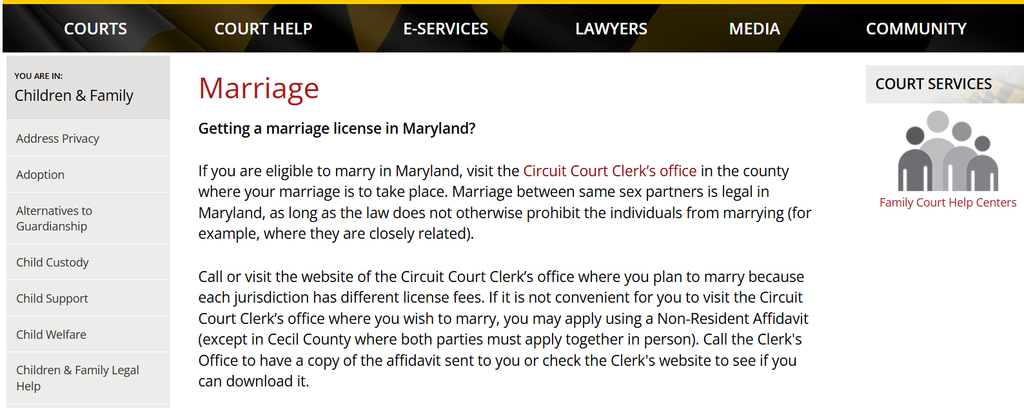
A Maryland marriage license is required before a legal marriage can take place in the state. The license is issued by the Clerk of the Circuit Court for the county or Baltimore City where the marriage ceremony will be performed. You do not apply based simply on where you live. The location of the ceremony determines the issuing jurisdiction.
The basic process is straightforward, but local procedures, fees, office hours, payment methods, and civil ceremony arrangements can differ. Maryland law generally allows one party to apply in person, while couples who live outside the ceremony county may have a non-resident affidavit option.
Where to Get a Maryland Marriage License
Apply in the Ceremony County
Maryland law requires the marriage license to be issued by the clerk for the county where the ceremony will occur. For example, if a couple lives in Frederick County but plans to have the legal ceremony in Baltimore County, the license must come from Baltimore County.
This rule is important because a license issued by one Maryland jurisdiction is not simply interchangeable with one issued by another. The ceremony must take place in the jurisdiction that issued the license.
Baltimore City Is a Separate Jurisdiction
Baltimore City is treated separately from Maryland’s counties for marriage licensing purposes. Couples planning a ceremony there should use the Clerk of the Circuit Court for Baltimore City’s licensing instructions rather than assuming Baltimore County procedures apply.
The Maryland Judiciary advises couples to contact the appropriate Circuit Court Clerk before applying because fees and local procedures can vary.
Maryland Marriage License Requirements
Information for Both Applicants
Maryland law requires information about both people getting married. The application includes details such as:
- Full legal names
- Current residences
- Dates of birth
- Marital status
- Social Security numbers, when applicable
- Whether either person was previously married
- Information about any previous marriage that ended through death or a legal proceeding
- Whether the parties are related by blood or marriage
The applicant also signs the application and provides documentation showing the age of each party.
Because local clerks can have additional procedural instructions, it is sensible to check the specific county’s marriage-license page before visiting.
Identification and Proof of Age
Maryland law requires an official government-issued birth certificate or another official government-issued document or record demonstrating age. County offices may also require photo identification as part of their application process. For example, Baltimore County lists a driver’s license, passport, or similar government-issued document among acceptable age documentation.
A practical approach is to bring valid photo identification for both parties, even though only one person may need to appear to submit the application.
Social Security Information
Applicants who have Social Security numbers must provide them as part of the marriage-license application. Maryland law also protects those numbers from being disclosed as part of the public record, subject to applicable law.
This is one reason applicants should use the official clerk’s office or an official Maryland court form when submitting personal information.
Do Both People Have to Apply in Person?
Usually, One Party Can Apply
Maryland law generally permits one person getting married to appear before the clerk and provide the required information for both parties. Several county court pages confirm this procedure.
The person applying should be prepared to provide accurate information about the other applicant. The exact documents that must accompany the application can depend on the county.
Non-Resident Marriage License Affidavit
A different option may apply when neither person lives in the county where the ceremony will take place. Maryland provides a Non-Resident Marriage License Application-Affidavit for this situation. The Maryland Judiciary specifically notes this option for applicants who cannot conveniently visit the clerk’s office in the ceremony county.
The affidavit does not mean couples can choose any county simply because its office is more convenient. The license still comes from the jurisdiction where the ceremony is scheduled.
The official Maryland non-resident form explains that the application is submitted to the clerk for the Maryland county or Baltimore City where the ceremony will occur.
What If You Were Married Before?
Divorce or Death of a Previous Spouse
If either person was previously married, the application requires information about how that marriage ended. Maryland law specifically calls for the date and place of a death or judicial determination that ended a previous marriage.
County clerks may have different instructions about supporting documents. Some offices may request additional documentation in particular circumstances, such as a very recent divorce or death.
Before visiting, have the relevant details available:
- Date the previous marriage ended
- County and state where a divorce was granted
- Date and place of a former spouse’s death, when applicable
If you are unsure whether a divorce decree or death certificate is required, confirm the requirement with the clerk issuing the new license.
Maryland Marriage License Fees
Fees Vary by County
There is no single statewide amount that every couple pays at the clerk’s counter. Maryland law establishes a $10 base license fee and permits counties to impose additional charges within limits set by state law. Anne Arundel County has a separate statutory authorization for an additional amount.
As a result, the amount shown on one county’s website may not apply to another county.
For example, current Maryland Courts information lists a $35 marriage-license fee in Talbot County, while Baltimore County also lists $35. Other jurisdictions can charge different amounts.
Civil Ceremony Fees
The marriage-license fee is separate from the cost of a civil ceremony when the ceremony is performed by a judge, clerk, or designated deputy clerk.
Maryland law establishes a fee for certain court-performed ceremonies, and county pages may show the current amount and payment procedure. The Maryland Courts general marriage page advises applicants to check the local clerk because ceremony hours, locations, and fees vary.
Do not assume that paying for the license automatically includes a courthouse ceremony.
Is There a Waiting Period?
When the License Becomes Effective
A Maryland marriage license does not normally become effective immediately after it is issued. It becomes effective at 6:00 a.m. on the second calendar day after issuance, unless an exception applies.
For example, if a license is issued on a Monday, the normal effective time is 6:00 a.m. on Wednesday.
This timing matters when scheduling a wedding close to the application date. A couple should not assume that receiving the physical license means the ceremony can legally take place immediately.
Can the Waiting Period Be Waived?
Maryland courts recognize circumstances in which a court can grant an exception to the normal waiting period. The general Maryland Courts guidance states that the license becomes effective after the standard waiting period unless the court grants an exception.
If you need to marry sooner than the normal waiting period allows, contact the clerk in the jurisdiction where the ceremony will take place and ask about the current waiver procedure.
How Long Is a Maryland Marriage License Valid?
Six-Month Validity
Once effective, a Maryland marriage license is valid for six months. The ceremony must take place within that period or the license expires.
This gives couples flexibility when planning a wedding, but it is still important to check the effective date printed on the license rather than calculating the deadline from memory.
The six-month period also means applying extremely early is unnecessary. Ideally, coordinate the application with your planned ceremony date and the local clerk’s office schedule.
Is a Blood Test Required in Maryland?
No Routine Blood Test
Maryland does not require a blood test as a condition for obtaining a marriage license. Current Maryland marriage-license information focuses on identity, age, residency, marital status, and other legally required application information rather than a medical examination.
This is useful to know because older marriage-license information found online can describe requirements that no longer apply.
Marriage Age Requirements
Applicants 18 or Older
An individual who is 18 or older can generally marry without the special minor-consent requirements that apply to a 17-year-old.
Applicants Who Are 17
Maryland law places specific restrictions on marriage at age 17. A 17-year-old generally needs the consent of each living parent, guardian, or legal custodian. If the required consent is unavailable, Maryland law provides a different route involving medical certification in specified circumstances and a court authorization order.
Under 17
A person under 17 may not marry in Maryland. This restriction was part of the changes to Maryland’s marriage laws effective in 2022.
Because minor-marriage rules involve additional legal documentation, anyone in this situation should speak directly with the Circuit Court Clerk before making plans.
What Happens After the Wedding?
The Officiant Returns the Marriage Certificate
Obtaining the license is only one part of the legal process. After the ceremony, the authorized official who performed the marriage must return the appropriate marriage certificate to the clerk who issued the license. Maryland law generally requires that return within five days of the ceremony.
The couple should keep the document provided to them after the ceremony and follow the clerk’s instructions regarding certified copies.
License vs. Marriage Certificate
These terms are often confused:
| Document | Main purpose |
|---|---|
| Marriage license | Gives the couple legal authorization to marry |
| Marriage certificate | Records that the marriage ceremony took place |
| Certified marriage certificate | An official certified copy used when an agency or organization requires proof of marriage |
The Maryland Department of Health provides information about obtaining marriage certificates, including options for ordering certain records online or by mail.
How to Get a Certified Marriage Certificate
Contact the Appropriate Records Office
For a marriage that has already taken place, the procedure for obtaining a certified copy depends on when and where the marriage occurred. Maryland’s official public-records portal directs users to the appropriate service for requesting a marriage certificate.
For some records, the Clerk of the Circuit Court in the county where the license was issued can provide certified copies. Maryland Courts information, for example, identifies the issuing county’s clerk as a source for certified copies in applicable circumstances.
The Maryland Department of Health’s Division of Vital Records also provides marriage-certificate ordering information and identifies online and mail options for eligible records.
Common Mistakes to Avoid
Applying in the Wrong County
The most important mistake is applying based on residence instead of the ceremony location. The license must be issued by the appropriate jurisdiction where the marriage will be performed.
Ignoring the Waiting Period
Receiving the license does not normally mean you can hold the ceremony immediately. Remember the 6:00 a.m. second-calendar-day rule.
Checking an Old Fee
County fees can change. A fee listed on an old blog or third-party website may no longer be accurate. Maryland Courts specifically advises couples to contact the relevant clerk because fees differ by jurisdiction.
Forgetting Previous-Marriage Details
Applicants who were previously married should have accurate information about each prior marriage and how it ended. This can prevent delays when completing the application.
Treating the License as the Final Record
The license authorizes the marriage; the completed marriage certificate documents that the ceremony occurred. Couples who need proof for a name change, benefits, immigration matter, insurance, or another official purpose may need a certified copy.
Maryland Marriage License Checklist
Before visiting or submitting an application, prepare the following:
- Confirm the ceremony location. Identify the Maryland county or Baltimore City where the legal ceremony will occur.
- Find the correct Circuit Court Clerk. Use the Maryland Judiciary’s official information rather than relying on an old third-party listing.
- Check the current fee. County charges vary.
- Prepare identification and age documents. Have government-issued documents available for both parties.
- Gather Social Security information. Provide the numbers when applicable.
- Prepare prior-marriage information. Know the dates and locations of divorces or deaths of former spouses.
- Check the application procedure. Determine whether one party can apply in person or whether a non-resident affidavit is appropriate.
- Confirm the waiting period. Plan the application date around the 6:00 a.m. second-calendar-day effective time.
- Check the license expiration date. The license is generally valid for six months.
- Plan for the marriage certificate. After the ceremony, know how to obtain a certified copy if one is needed.
Frequently Asked Questions
Can you get married in Maryland if you do not live there?
Yes. Maryland does not require couples to be Maryland residents simply to marry in the state. The important rule is that the license must be obtained from the jurisdiction where the ceremony will take place. Non-resident couples who cannot conveniently visit that clerk’s office may have an affidavit option.
Can one person apply for the marriage license?
Generally, yes. Maryland law permits one party to appear before the clerk and provide the required information for both parties. Local instructions should still be checked before applying.
How quickly can you get a Maryland marriage license?
The clerk may issue the license when the application is made, but it normally does not become effective until 6:00 a.m. on the second calendar day after issuance.
How long does a Maryland marriage license last?
A Maryland marriage license is generally valid for six months from the effective date stated on the license. The marriage ceremony must take place within that period.
Does Maryland require a blood test to get married?
No. A blood test is not a standard requirement for obtaining a Maryland marriage license.
How much does a Maryland marriage license cost?
There is a statewide statutory base fee, but counties and Baltimore City can impose additional charges. The final amount therefore depends on the jurisdiction issuing the license. Check the local Circuit Court Clerk for the current fee before applying.
Where can I get a copy of a Maryland marriage certificate?
Depending on the record and date of the marriage, a certified copy may be available through the Clerk of the Circuit Court that issued the license or through the Maryland Department of Health’s Division of Vital Records. Maryland’s official public-records portal provides the appropriate starting point for certificate requests.
Final Takeaway
Getting a Maryland marriage license mainly requires choosing the correct issuing jurisdiction, preparing the required information and age documentation, paying the local fee, and allowing for the statutory waiting period. The license is tied to the county or Baltimore City where the ceremony will occur, not simply to the couple’s home address.
Because fees, office hours, payment methods, and local procedures can change, the safest final step is to verify the current instructions directly with the appropriate Circuit Court Clerk. Maryland’s courts provide county-specific marriage information, while the Maryland General Assembly provides the governing Family Law provisions.