Maryland jury duty is a legal responsibility for eligible residents who are summoned to serve. Receiving a jury summons does not necessarily mean you will sit on a trial, but it does mean you need to follow the instructions provided by the court.
The Maryland Judiciary handles jury service through local jury offices in each county and Baltimore City. The exact reporting process, service period, payment, and procedures can vary by jurisdiction, so the summons you receive should always be treated as the primary source for your specific service instructions.
This guide explains how Maryland jury duty works, who can serve, what to do after receiving a summons, how postponements and excusals work, what to expect at the courthouse, and what can happen if you fail to appear.
What Is Maryland Jury Duty?
Jury duty is the process through which eligible members of the public participate in Maryland’s court system. Jurors may be asked to hear evidence in a civil or criminal case and make decisions according to the law and instructions given by the judge.
Maryland courts select prospective jurors randomly from qualifying residents rather than allowing people to volunteer for service.
Why Are People Selected?
Jury selection is designed to create a jury pool representing a fair cross-section of eligible residents. Maryland jury offices use sources such as voter registration records and Maryland Motor Vehicle Administration records to identify prospective jurors.
Receiving a qualification form or summons therefore does not mean that a person has done anything wrong or is involved in a court case.
Jury Service Is Different From Being Selected
A person can be summoned for jury service without ultimately becoming a member of a trial jury.
Courts generally call more prospective jurors than they need because:
- Some people may be disqualified.
- Some prospective jurors may have valid reasons for being excused.
- Attorneys may challenge prospective jurors.
- A case may settle before trial.
- The court may ultimately need fewer jurors than expected.
For this reason, reporting for jury duty does not automatically mean you will spend several days sitting on a trial.
Who Can Serve on a Maryland Jury?
Maryland law establishes qualifications for jury service. In general, a person must be an adult, a U.S. citizen, and a resident of the county where the person is expected to serve.
There are also circumstances that can make someone legally disqualified from jury service.
Basic Eligibility
The Maryland Courts identify the following general qualifications:
- You must be at least 18 years old.
- You must be a U.S. citizen.
- You must reside in the Maryland county or Baltimore City where you would serve.
- You must be able to understand, read, write, and speak English sufficiently for jury service.
The law also addresses certain criminal convictions, pending criminal charges, and disabilities that may prevent satisfactory jury service.
Because eligibility rules can change, anyone who believes they are disqualified should review the qualification form and contact the appropriate local jury office rather than simply ignoring a summons.
Possible Exemptions
Some people who otherwise qualify may be exempt from jury service under Maryland law.
For example, a person who is at least 70 years old may request an exemption. Certain members of the military and members of Congress may also qualify for an exemption under applicable requirements.
An exemption is different from simply asking to postpone service. If you believe an exemption applies to you, follow the documentation instructions provided with your qualification form.
What Is the Maryland Juror Qualification Form?
The Juror Qualification Form helps the court determine whether a person is qualified to serve.
If you receive one, you should not treat it as optional paperwork. Maryland Courts state that the form generally must be completed and returned within 10 days of receipt.
What Information Does It Ask For?
The form is used to collect information needed to determine eligibility and maintain accurate juror records. Depending on the process available in your jurisdiction, you may be able to provide the information online.
You may also need to provide supporting documentation if you are requesting an exemption, disqualification, accommodation, or other action.
Can You Complete It Online?
Many Maryland counties and Baltimore City provide an online qualification process through the Maryland Judiciary’s jury service system.
The online system may allow an eligible prospective juror to:
- Complete the qualification form.
- Confirm service information.
- Update certain personal information.
- Request a one-time change of the service date where available.
If your county does not support the requested online process, follow the mailing or other instructions printed on your form.
What Does a Maryland Jury Summons Mean?
A jury summons is a formal notice requiring a prospective juror to report for jury service at a specified time and place.
The summons is more important than a general website or search result because jury procedures vary among Maryland counties and Baltimore City.
Check Your Summons Carefully
Look for details such as:
- Your reporting date.
- Service period.
- Reporting number.
- Juror identification number.
- Courthouse location.
- Reporting time.
- Call-in or online reporting instructions.
- Contact information for the local jury office.
Keep the summons available throughout the service period. You may need information printed on it when checking your reporting status or contacting the jury office.
How to Report for Maryland Jury Duty
Reporting procedures depend on the court and the instructions printed on your summons.
Some prospective jurors must call a recorded jury information line or check an online system before reporting. The court uses these systems to determine how many people are actually needed.
Check Before You Go
A jury trial may be postponed or a case may settle, reducing the number of jurors required for a particular day.
If your instructions tell you to call or check online, do so at the specified time. If the court tells you that you do not need to report, follow that instruction.
If your summons does not require a call-in or online check, you generally need to appear at the courthouse on the date and time listed.
Arrive Early
Give yourself enough time to:
- Find the courthouse.
- Locate parking or public transportation.
- Go through security.
- Find the correct courtroom or jury assembly area.
- Check in before the required reporting time.
Courthouses are secure facilities, and screening can take time.
What Happens When You Arrive?
Your first day may involve orientation, administrative processing, waiting, and jury selection rather than immediately hearing evidence in a trial.
The exact process differs by court and the type of jury service involved.
Jury Selection
If you are part of a pool being considered for a particular trial, the court and attorneys may ask questions to determine whether prospective jurors can be fair and impartial.
This process is commonly called voir dire.
The purpose is not to test your legal knowledge. Jurors are expected to listen carefully, answer questions honestly, and follow the judge’s instructions.
You May Not Be Selected
It is completely normal for prospective jurors to report without being selected for a jury.
You could be released because another group of jurors is selected, because the parties resolve the case, or because the court no longer needs the entire pool.
Trial Jury vs. Grand Jury
Maryland has different types of jury service, and the distinction matters when reading your summons.
Trial Jury
A trial jury hears evidence in a specific civil or criminal case. In a criminal matter, the jury may determine whether the defendant is guilty based on the evidence and applicable law. In civil cases, jurors may decide issues such as liability and damages.
Most people who receive ordinary trial jury summonses are participating in this type of jury service.
Grand Jury
A grand jury performs a different function. Rather than deciding whether a defendant should be found guilty at trial, a grand jury considers evidence to determine whether there is probable cause to charge someone with a crime and may conduct investigations.
Grand jury service can involve a substantially different schedule and duration from trial jury service.
Always check your summons to determine which type of service you have been assigned.
How Long Is Maryland Jury Duty?
There is no single statewide number of days that applies to every juror.
Maryland Courts state that the length of jury service is established by the individual Circuit Court. Local jury plans therefore matter when determining the expected service period.
Service Period vs. Trial Length
These are not necessarily the same thing.
Your summons may place you in a service period lasting several days, weeks, or another period established by your local court. That does not mean you will necessarily be in court every day.
If you are selected for a trial, the judge will provide instructions about the expected length and reporting schedule.
Can You Postpone Maryland Jury Duty?
In some circumstances, Maryland jurors can request a different service date.
A postponement is generally more appropriate when you have a significant scheduling conflict but are still able to serve at another time.
Common Reasons for a Request
Examples can include:
- A previously scheduled medical procedure.
- Significant travel plans.
- An important personal obligation.
- Other circumstances that create a substantial scheduling conflict.
The fact that jury duty is inconvenient does not automatically mean a request will be approved.
Some counties allow a one-time postponement through the online jury system. If online rescheduling is unavailable, contact your local jury office using the information on your summons.
Do Not Wait Until the Last Minute
If you know about a conflict, submit your request as early as possible.
Local courts may have specific deadlines for written requests, and approval is not automatic. Until the court confirms that your service has been changed, you should continue following the original summons instructions.
Can You Be Excused From Jury Duty?
An excusal is different from a postponement.
Maryland law permits excusal in limited circumstances, including situations involving extreme inconvenience, public necessity, or undue hardship. Certain other circumstances can also qualify under the applicable law.
Employment Alone Is Usually Not Enough
Having a job does not automatically remove the obligation to serve.
Maryland provides employment protections for people responding to jury summonses and attending jury service. An employer generally cannot fire, threaten, or intimidate an employee because of qualifying jury-service-related absence.
Employers are not generally required by Maryland law to pay an employee’s normal wages during jury service, although an employer may have its own paid-jury-duty policy.
Medical or Disability Issues
If a disability prevents satisfactory jury service, Maryland Courts provide an accommodation process.
If you need an accommodation to participate, contact the local jury office as soon as possible rather than waiting until the reporting date.
A medical condition that prevents satisfactory jury service may require documentation from a health care provider.
How Much Does Maryland Jury Duty Pay?
Maryland jurors receive a daily payment, commonly described by the Maryland Judiciary as a per diem.
The amount can vary by jurisdiction. Maryland Courts state that the general range is $30 to $40 per day, with a higher amount generally applying after five days on a single trial jury.
Because local payment rules can differ, check the jury information provided by your county before relying on a particular amount.
Does Your Employer Have to Pay You?
Not necessarily.
Jury service compensation from the court is separate from your employer’s payroll policy. Some employers provide paid time off or other compensation, while others do not.
You can ask your employer’s human resources department about its jury-duty policy.
What Should You Bring to Jury Duty?
Your summons should be the first item on your checklist.
You may also want to bring:
- Government-issued identification if required by the courthouse.
- Reading material.
- Work that can be completed during permitted waiting periods.
- Necessary medication.
- A sweater or light jacket.
- Food or water if permitted by the courthouse.
Courthouse security rules differ, so do not assume that everything you normally carry is allowed inside.
Electronic Devices
Maryland Courts permit electronic devices in many courthouse settings, but their use can be restricted or prohibited in designated areas.
Devices generally cannot be used in courtrooms in ways that violate court rules or instructions. Electronic devices are also not permitted in jury deliberation rooms.
If you are unsure, follow the directions of courthouse security and court staff.
Items to Leave at Home
Weapons and sharp objects are prohibited in courthouses.
Security screening may include a metal detector and inspection of bags. Avoid bringing anything that could create a security problem or delay your entry.
What Should You Wear?
Wear clean, comfortable clothing that is appropriate for a court setting.
You do not normally need formal business attire, but extremely casual clothing, offensive messages, or clothing that disrupts court proceedings should be avoided.
Courthouses can also be cool, so bringing an additional layer may make a long day more comfortable.
What Are Jurors Not Allowed to Do?
Jurors have a responsibility to decide cases based only on the evidence and instructions provided through the legal process.
That means you should not conduct independent research about a case.
Avoid Independent Research
Do not:
- Google a defendant, witness, attorney, or party.
- Search for information about the case online.
- Visit a location mentioned during testimony.
- Research evidence outside the courtroom.
- Look up information about witnesses.
- Ask friends or family for opinions about the case.
Even information that appears harmless can introduce material that was not properly presented to the jury.
Be Careful With Social Media
Do not post about a case, discuss case details through messages, or share opinions about the proceedings on social media.
This includes platforms such as Facebook, Instagram, X, TikTok, blogs, email, and text messaging.
If you have a question about something you can say or do while serving, ask the judge or jury office rather than making your own interpretation.
What Happens If You Miss Jury Duty?
Ignoring a jury summons can have serious consequences.
Maryland law provides penalties for failing to appear for jury service without good cause. A person who fails to appear may be ordered to explain the absence and can face a fine of up to $1,000, imprisonment for up to 60 days, or both.
There are separate penalties for failing to complete jury service as directed.
What If You Missed Because of an Emergency?
Do not assume that a missed appearance automatically means you are excused.
Contact your local jury office immediately and explain what happened. Maryland Courts specifically advise jurors facing an illness or family emergency to contact the local jury office for instructions.
If a medical issue is involved, the court may require supporting documentation.
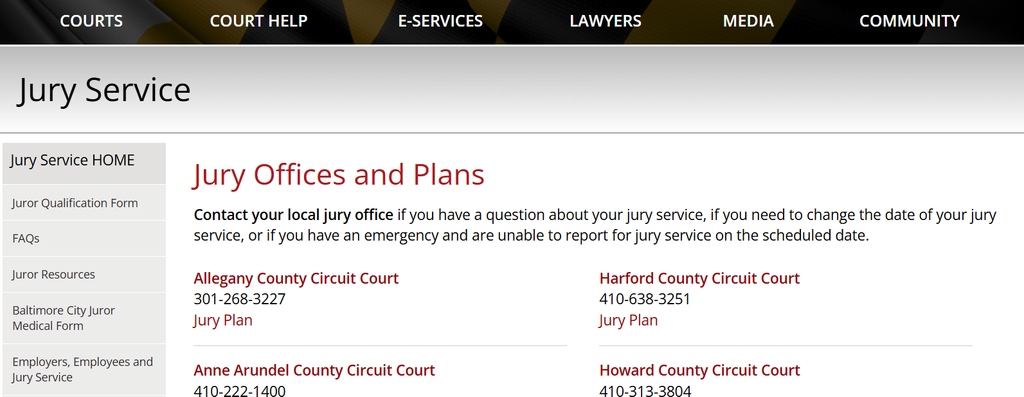
How to Find Your Local Maryland Jury Office
Maryland has local jury offices associated with the Circuit Courts in each county and Baltimore City.
The Maryland Judiciary publishes a directory containing local jury office telephone numbers and jury plans.
Use the local office when you need help with:
- A reporting question.
- A postponement request.
- An emergency.
- An accommodation.
- An exemption or excusal.
- Questions about your specific service period.
Your summons should also provide contact information for the office handling your service.
Common Mistakes to Avoid
A few mistakes can create unnecessary problems during jury service.
Ignoring the Qualification Form
If you receive the qualification form, complete and return it according to the instructions. Do not assume that receiving a form means you can wait until the reporting date.
Assuming You Are Automatically Excused
A work conflict, vacation, childcare issue, or other personal problem does not automatically cancel your service.
Submit the appropriate request and wait for confirmation.
Failing to Check Reporting Instructions
Some courts require jurors to call or check online before appearing. Others instruct jurors to report directly.
Follow the instructions for your particular court.
Researching a Case Online
Independent research can interfere with the fairness of a trial. Do not search for information about cases that could come before you.
Treating Every County the Same
Maryland’s counties and Baltimore City can have different jury plans, service periods, reporting systems, payment amounts, and local procedures.
Statewide information is useful for understanding the process, but your local court’s instructions control the details of your service.
Frequently Asked Questions
Is jury duty mandatory in Maryland?
For a person who is legally qualified and properly summoned, jury service is a civic and legal responsibility. You should not ignore a summons simply because you do not want to serve.
How old do you have to be for jury duty in Maryland?
You generally must be at least 18 years old to qualify for Maryland jury service. There is no general upper age limit, although people age 70 or older may request an exemption under applicable rules.
Can I postpone jury duty in Maryland?
A postponement may be available when you have a legitimate scheduling conflict. Some jurisdictions provide an online one-time postponement option, while others require you to contact the local jury office.
Can my employer fire me for jury duty in Maryland?
Maryland law provides employment protections related to jury service. An employer may not deprive an employee of employment or threaten or intimidate the employee because of qualifying jury-service-related absence.
How much does jury duty pay in Maryland?
The amount varies by jurisdiction. Maryland Courts state that the general per diem range is $30 to $40 per day, with higher compensation generally applying after five days on a single trial jury.
Do I have to report every day?
Not necessarily. Your local court determines the service schedule. Some jurors must call or check an online system before reporting, and you may not be required to appear if your reporting number is not called.
Can I bring my phone to jury duty?
Electronic devices may generally be brought into some courthouse areas, but their use is restricted in certain locations. Follow the instructions of the courthouse and judge. Never use a device to research or communicate about a case.
What happens if I cannot serve because of a disability?
Contact the local jury office as soon as possible. Maryland Courts provide an accommodation process, and documentation from a health care provider may be required when a disability prevents satisfactory jury service.
Final Takeaway
Maryland jury duty is managed through local courts, so the exact experience can differ depending on your county or Baltimore City. The most important step after receiving a summons is to read every instruction carefully and complete the required Juror Qualification Form on time.
If you need to change your service date, request an excusal, seek an accommodation, or report an emergency, contact the local jury office rather than simply failing to appear.
Once you report, follow the judge’s instructions, avoid independent research, protect the confidentiality of case-related information, and use only the evidence presented through the proper court process. Checking the Maryland Judiciary’s official jury-service resources before your reporting date can help you avoid preventable mistakes and understand what the court expects from you.