
Maryland criminal court records can help you find information about criminal cases filed in the state’s District and Circuit Courts. The main online starting point is the Maryland Judiciary Case Search, which provides public case information such as case numbers, charges, hearing dates, parties, and dispositions. However, Case Search is not the complete court file, and some criminal information is restricted or no longer displayed online.
Knowing the difference between an online case summary and the actual court record is important. It can prevent confusion when a case does not appear in a search or when information shown online seems incomplete.
This guide explains how Maryland criminal court records work, where to search, what information you can find, when you may need to visit a courthouse, and how expungement and shielding affect public access.
What Are Maryland Criminal Court Records?
Maryland criminal court records are documents and case information created or filed during a criminal proceeding. Depending on the case, the record may contain charging information, docket entries, hearing information, motions, orders, judgments, and other filings.
Most court records are generally open to public inspection unless a law, court rule, or court order restricts access. Maryland Courts explains that Case Search provides a summary of information contained in the official case file rather than the complete file itself.
What Information May Be Available?
A Case Search result can provide information such as:
- Defendant or other party name
- Case number
- Court and jurisdiction
- Filing information
- Charges
- Trial or hearing dates
- Case status
- Case disposition
- Other docket information
The exact information available depends on the case and applicable public-access rules.
Case Search Is Not the Complete File
This distinction matters when researching an older or complicated criminal matter.
The Maryland Judiciary states that Case Search is useful for general case information, but the complete case file should be viewed through the appropriate clerk’s office. Some documents may therefore be available at the courthouse even when they are not displayed online.
Where to Search Maryland Criminal Court Records
The Maryland Judiciary Case Search is the primary online resource for publicly available Maryland court case information.
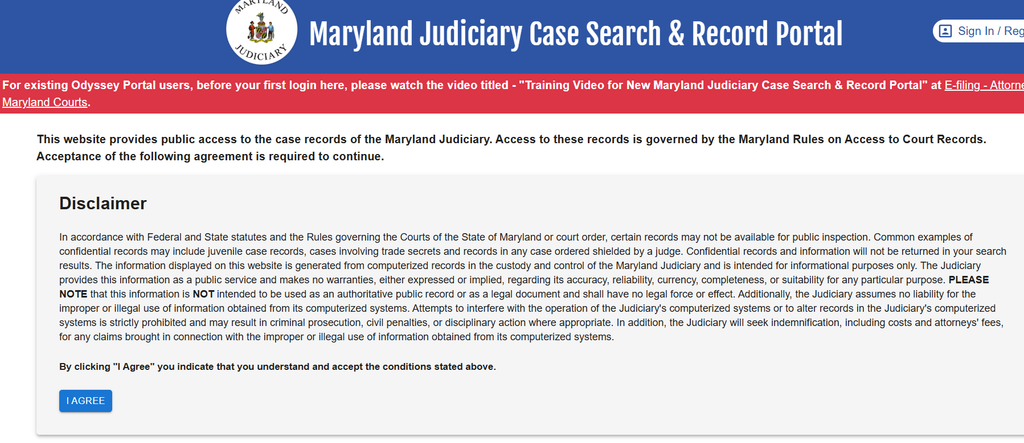
It provides access to Maryland District Court criminal records and Maryland Circuit Court criminal records, along with certain civil and traffic information.
Search by Person
A name search is useful when you do not know the case number.
Maryland’s current Case Search system defaults to exact-name searches. For a partial last-name search, the Judiciary says to enter at least the first character of the last name followed by %. Partial first-name searches can also use %, subject to the system’s search rules.
When searching a common name, use additional information where available. Otherwise, the results may include numerous unrelated cases.
Search by Case Number
A case number is usually the most precise way to locate a particular proceeding.
If you already have the case number from a court notice, previous filing, attorney, or other reliable source, use it instead of relying only on a person’s name.
Narrow a Large Search
Case Search can return a maximum of 600 records for a search. If more than 600 records match, the system instructs users to narrow the search by adding information such as a filing date range, first name, court, or case type.
This is particularly useful for common names.
District Court vs. Circuit Court Records
One reason a criminal-record search can be confusing is that Maryland has different trial courts with different jurisdictions.
District Court Criminal Cases
The District Court handles criminal misdemeanors and certain felonies. It also handles preliminary proceedings for crimes charged in Maryland.
The District Court does not conduct jury trials. When a criminal matter requires a jury trial, the case can be moved to a Circuit Court.
Circuit Court Criminal Cases
Circuit Courts are Maryland’s courts of general jurisdiction and handle more serious criminal matters. They also hear certain criminal cases transferred from the District Court and other matters within their jurisdiction.
Maryland has Circuit Courts in each of its 23 counties and Baltimore City. The Maryland Judiciary also maintains a court directory that identifies the appropriate jurisdictions and court locations.
Why the Court Type Matters
If you are trying to obtain the complete file, identifying the correct court is important.
For example, finding a Circuit Court case number in Case Search does not mean every document connected with that case will be available through the online search page. The clerk’s office generally maintains the underlying judicial record.
How to Search Maryland Criminal Court Records Online
A basic search can usually be completed in a few steps.
Step 1: Gather Identifying Information
Before searching, collect as much information as possible.
Useful details include:
- Full legal name
- Approximate case date
- County or Baltimore City
- Case number
- Date of birth, where appropriate
- Court type
- Approximate charge or offense
You do not necessarily need all of these details. Even a person’s name can be enough to begin.
Step 2: Open Case Search
Go to the Maryland Judiciary’s Case Search system and select the appropriate search option.
Because Case Search uses CAPTCHA and public-access controls, users may be required to complete the system’s verification before viewing results.
Step 3: Review Matching Cases
Compare the search results carefully rather than assuming the first matching name is the correct person.
Look at the available identifying information, including the court, case number, dates, and case type.
Step 4: Examine the Case Information
Once you identify the likely case, review the available charges, docket entries, hearing information, and disposition.
The disposition is particularly important because an arrest or charge does not by itself establish that a person was convicted.
Understanding Criminal Case Dispositions
A criminal case can end in different ways, and the terminology used in court records can be unfamiliar.
Conviction
A conviction means the defendant was found guilty or entered a guilty plea, depending on how the case was resolved.
The consequences and record-access rules can depend on the specific disposition and offense.
Acquittal or Not Guilty
An acquittal or not-guilty outcome does not mean the defendant was convicted of the charged offense.
Maryland has specific rules affecting how certain acquitted or not-guilty charges appear in Case Search.
Dismissal
A dismissed charge does not result in a conviction on that charge. The reason for dismissal and the rest of the case history may require reviewing the actual court file.
Nolle Prosequi
A nolle prosequi, often shortened to nolle pros, means the prosecution has decided not to proceed with the charge.
It is important not to interpret every case-status term as equivalent to a conviction.
Stet
A stet is a Maryland criminal case disposition with specific legal consequences. Maryland’s current Case Search notices state that, under the Expungement Reform Act of 2025, charges recorded as stet are removed from the docket after three years.
Because the treatment of dispositions can change through legislation, users should check current Maryland Judiciary guidance rather than relying on an older explanation of a term.
Why a Criminal Case May Not Appear Online
Not finding a case through Case Search does not necessarily mean that the case never existed.
Several explanations are possible.
The Record Is Restricted
Certain criminal records are not available for unrestricted public inspection. Maryland rules restrict access to categories of information involving matters such as certain warrants, presentence investigations, grand-jury investigations, and other protected records.
The Case Has Been Expunged
An expunged criminal record is removed from public inspection. Maryland Courts explains that expungement can remove information from court and law-enforcement records, subject to the applicable legal process.
The Case Has Been Shielded
Shielding is different from expungement. A shielded case is removed from public view but is not necessarily erased from all government records.
Maryland Courts states that certain eligible convictions may be shielded under the Maryland Second Chance Act. Law enforcement and certain authorized agencies may still have access.
The Case Is Not Displayed Because of Its Disposition
Maryland has specific rules concerning criminal information that is suppressed from Case Search.
The Judiciary currently states that certain charges resulting in acquittal, dismissal, nolle prosequi, or not-guilty dispositions may be automatically suppressed. The courthouse may still provide access to records that are no longer shown online.
This is one of the most important reasons to avoid treating an online Case Search result as the entire criminal record.
How to Get the Complete Court File
If the information available online is not enough, contact the clerk’s office for the court where the case was filed or heard.
Contact the Appropriate Clerk
Maryland Courts states that most judicial records are held by local Clerk’s Offices. Requests to inspect or obtain documents should generally be directed to the clerk’s office where the case was filed or where the hearing or trial occurred.
You can use the Maryland Courts directory to locate the appropriate courthouse.
Request Specific Documents
A request is easier to process when you identify what you actually need.
For example, you might request:
- Charging documents
- Docket entries
- Judgment or disposition documents
- Court orders
- Specific motions
- Sentencing documents
- Other publicly accessible filings
Not every document will necessarily be available for public inspection.
Copies and Fees
Copy fees can apply when you request paper copies of judicial records. Maryland’s Circuit Court fee schedule lists a general copy charge of 50 cents per page. Local clerk offices may also provide specific instructions for requests, including payment and mailing procedures.
Because procedures can vary by court and request type, confirm the current requirements with the clerk before sending payment or traveling to the courthouse.
What You Should Not Use Case Search For
Maryland Judiciary specifically warns that Case Search should not be used as a criminal background-check service.
For official criminal-history background checks, the Judiciary directs users to the Criminal Justice Information System, or CJIS, operated through the Maryland Department of Public Safety and Correctional Services. CJIS maintains Maryland’s fingerprint-supported criminal identification and criminal-history records.
Court Record vs. Background Check
These are different searches with different purposes.
| Search | Main Purpose |
|---|---|
| Maryland Case Search | Public information about court cases |
| Clerk’s Office | Access to the underlying court file |
| CJIS background check | Criminal-history/background-check purposes |
| Expungement process | Removal of eligible records from public inspection |
| Shielding | Restricting public access to certain eligible records |
Using the wrong source can produce an incomplete or misleading result.
Privacy, Sealing, Shielding, and Expungement
Public access to criminal records is not unlimited.
Sealed Records
A court may restrict access to certain records when authorized by law or court rule. Some information may be unavailable to the public even when the broader case remains accessible.
Shielded Records
Shielding removes eligible records from public view without necessarily eliminating them from government systems. Maryland’s shielding rules include eligibility requirements and restrictions.
Expunged Records
Expungement is a more extensive process. Maryland Courts describes it as removing information from court and law-enforcement records covered by the applicable expungement order.
Eligibility depends on the disposition, offense, timing, and other legal requirements.
As of October 2026, Maryland’s Judiciary lists different expungement forms and procedures depending on the case disposition, including forms for acquittal, dismissal, probation before judgment, nolle prosequi, stet, and certain guilty dispositions.
Common Mistakes When Searching
A few mistakes can make a Maryland criminal-record search unnecessarily difficult.
Searching Only a Common Name
A name alone may produce many results. Add a county, approximate date, court, or other identifying information when possible.
Assuming Case Search Is the Full Record
It is not. Case Search provides selected case information, while the clerk’s office can provide access to the underlying file when the record is publicly available.
Treating Every Charge as a Conviction
A charge, arrest, dismissal, acquittal, and conviction are not interchangeable. Always review the disposition before drawing conclusions about the outcome.
Assuming a Missing Record Never Existed
A record may be absent because it has been expunged, shielded, suppressed, restricted, or otherwise excluded from online public access.
Using Case Search as a Background Check
The Maryland Judiciary expressly advises against this. Use the appropriate CJIS process when an official criminal-history check is required.
Frequently Asked Questions
Is Maryland Criminal Court Case information public?
Generally, many Maryland court records are open to public inspection, but numerous exceptions apply. Expunged, shielded, sealed, confidential, and otherwise restricted information may not be publicly available.
Can I search Maryland criminal cases online?
Yes. Maryland Judiciary Case Search provides online access to public information from District Court and Circuit Court case records. The online system does not provide every document contained in a court file.
Can I search by someone’s name?
Yes. Case Search supports person-name searches. The system now defaults to exact-name searching, while partial searches use specific wildcard rules.
Why can’t I find a Maryland criminal case?
The case may have been expunged, shielded, restricted, suppressed from Case Search, or otherwise unavailable through the online system. Some criminal information may still be accessible at the courthouse even when it is no longer displayed online.
Does Maryland Case Search show the entire court file?
No. Case Search provides a summary or selected information from the official case record. For the complete publicly accessible file, contact the appropriate clerk’s office.
Can I use Maryland Case Search for a background check?
No. Maryland Courts specifically advises that Case Search should not be used for criminal background checks. The Judiciary directs users to CJIS for Maryland criminal-history background-check purposes.
Can I obtain a copy of a Maryland criminal court record?
Generally, publicly accessible court records can be inspected and copies can be requested through the appropriate clerk’s office. Fees may apply, and restricted portions cannot necessarily be copied or inspected.
Are dismissed criminal cases visible on Case Search?
Not necessarily. Maryland’s current access rules provide for suppression of certain criminal charges with dispositions such as dismissal, acquittal, not guilty, or nolle prosequi. Some of those records may still be available at the courthouse.
Final Takeaway
Maryland criminal court records are easiest to research when you use the right source for the right purpose. Maryland Judiciary Case Search is the practical starting point for finding public case information online, including case numbers, charges, dates, and dispositions. It is not, however, a substitute for the complete court file or an official criminal background check.
When an online search produces incomplete information, the next step is usually the appropriate District or Circuit Court clerk’s office. The clerk can explain how to inspect or request publicly accessible documents. If a case cannot be found online, consider whether the record may have been expunged, shielded, suppressed, sealed, or otherwise restricted.
For background checks, use Maryland’s CJIS process rather than relying on Case Search. For questions involving expungement, shielding, or legal consequences, consult the current Maryland Judiciary guidance or a qualified attorney because eligibility and procedures can change as Maryland law is amended.