
A Maryland warrant search is generally performed through Maryland court records, local court offices, or law-enforcement agencies, depending on the type of warrant involved. Maryland does not provide one simple public webpage that displays every active warrant in the state.
For many people, the best starting point is the Maryland Judiciary’s Case Search, which provides public access to selected information from District Court and Circuit Court records. However, an online case result does not necessarily provide a complete picture of a person’s current warrant status. Some warrant-related records are restricted, and Case Search is not the official court file.
Understanding these limitations is important before treating a search result as confirmation that a warrant is active.
What Is a Warrant in Maryland?
A warrant is a legal order issued under specific circumstances that authorizes law enforcement to take a particular action. Maryland rules distinguish between different types of warrants, including arrest warrants, bench warrants, and search warrants.
Arrest Warrants
An arrest warrant commands a peace officer to arrest the person named in the warrant. Depending on the court and circumstances, an arrest warrant may be issued by a judge or, in certain District Court matters, a commissioner. Maryland Rule 4-212 establishes circumstances under which an arrest warrant may be issued.
An arrest warrant is connected to a criminal allegation or charging document. Its existence does not by itself establish that the accused person is guilty.
Bench Warrants
A bench warrant is an arrest warrant issued by a judge when a defendant fails to appear in court as required. The Maryland Judiciary’s glossary specifically defines a bench warrant in connection with failure to appear.
A missed court appearance can therefore be an important reason to investigate whether a bench warrant may have been issued.
Search Warrants
A search warrant is different from an arrest warrant. It authorizes law enforcement to conduct a search under the authority and conditions specified by the warrant.
Search-warrant records can have different public-access rules from ordinary court case information. Maryland Courts explains that certain warrant applications and supporting materials may not be publicly accessible before execution and filing, subject to applicable rules and court authorization.
Where Can You Perform a Maryland Warrant Search?
There is no single public database that should be treated as a complete statewide warrant list. The appropriate source depends on what you are trying to verify.
Maryland Judiciary Case Search
The Maryland Judiciary Case Search is usually the most useful online starting point for publicly available court information.
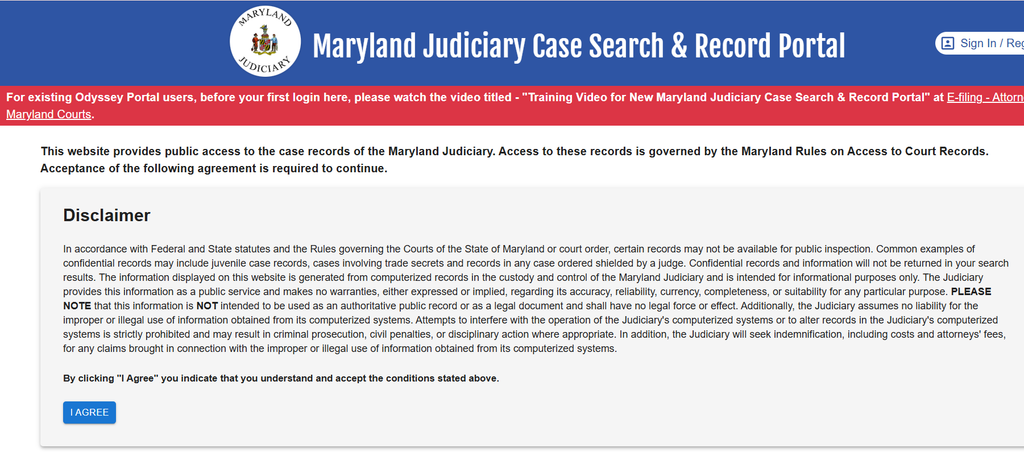
It provides access to selected information from Maryland District Court and Circuit Court cases, including information such as case numbers, parties, charges, dates, and dispositions.
Case Search should be viewed as a way to locate and review available case information rather than as a dedicated warrant-status database.
Local Clerk’s Office
If an online search does not answer the question, the clerk’s office for the relevant Maryland court may be able to explain how to inspect the underlying case record.
Maryland Courts states that most judicial records are maintained by local clerk’s offices. A person seeking a complete case file may need to contact or visit the courthouse where the case was filed or where the hearing occurred.
Law Enforcement or Sheriff’s Office
For questions involving an active warrant, the appropriate law-enforcement agency may also be relevant. The correct agency can depend on the jurisdiction and circumstances.
However, a person should verify contact information independently through an official government website rather than relying on a phone number supplied by an unexpected caller.
How to Search Maryland Court Records
A careful search can help you determine whether publicly available court information corresponds to a possible warrant.
Step 1: Open Maryland Case Search
Begin with the Maryland Judiciary’s Case Search system. The service provides public access to available information from Maryland court records.
Do not assume that every criminal record or warrant will appear. Maryland law and court rules restrict access to certain records.
Step 2: Search by Name
Enter the person’s legal name as accurately as possible.
Maryland Case Search normally defaults to exact-name searches. The Judiciary explains that partial-name searches can be performed using the required percentage-symbol format.
When several people have similar names, use additional information to narrow the results.
Step 3: Review the Case Details
Look beyond the case title. Review available information such as:
- Case number
- Court
- Filing date
- Criminal charge
- Defendant information
- Hearing dates
- Case disposition
- Available docket information
- Warrant-related entries, when displayed
A case involving a warrant may contain docket entries indicating that a warrant was issued, served, recalled, or otherwise addressed.
Step 4: Check the Status Carefully
Do not automatically interpret the appearance of a warrant-related entry as proof that the warrant remains active.
The case history may contain later events that changed the warrant’s status. For example, Maryland court forms recognize actions involving the recall of an arrest warrant or bench warrant.
If the online information is unclear, contact the appropriate court for confirmation.
Why a Warrant May Not Appear Online
One of the biggest mistakes in a Maryland warrant search is assuming that a missing online result means no warrant exists.
Some Records Have Restricted Access
Maryland Courts states that certain criminal records involving warrants are not available to the public in the same manner as ordinary case information. Restrictions can apply to warrant applications, supporting affidavits, and certain arrest-warrant records.
This means an online search may not reveal everything known to the court or law enforcement.
Case Search Is Not the Complete Court File
Case Search provides selected information rather than the complete official case record.
Maryland Courts specifically explains that Case Search is a summary of information contained in the official file. For a complete record, the user may need to inspect the file through the appropriate clerk’s office.
Records May Be Shielded, Sealed, or Expunged
Some court information is not publicly available because of shielding, sealing, expungement, statutory restrictions, or court orders.
The Maryland Judiciary notes that records protected by the Maryland Rules on Access to Court Records will not necessarily appear in public searches.
Maryland Warrant Search vs. Criminal Background Check
These are not the same type of search.
A warrant search generally focuses on whether court or law-enforcement information indicates a warrant. A criminal background check is designed to provide criminal-history information through an authorized records system.
Why Case Search Is Not a Background Check
The Maryland Judiciary explicitly advises users not to use Case Search as a criminal background check. Maryland’s Criminal Justice Information System, operated by the Department of Public Safety and Correctional Services, handles fingerprint-supported criminal identification and criminal-history records.
If an employer, licensing authority, or another organization requires a formal background check, using the appropriate CJIS process is more appropriate than relying on a public court-record search.
What Information Can a Maryland Court Search Show?
The amount of information available varies by case and record type.
Common Information
Depending on the case, Case Search may show information such as:
| Information | What It Can Tell You |
|---|---|
| Case number | Identifies the court case |
| Court | Shows the Maryland court handling the matter |
| Party name | Helps identify the person connected with the case |
| Charge | Shows the alleged offense or matter |
| Filing date | Indicates when the case entered the court system |
| Hearing date | Shows scheduled or recorded proceedings |
| Disposition | Shows the recorded outcome of the case |
| Docket entries | May show important actions taken in the case |
The Maryland Judiciary confirms that Case Search can provide names of parties, case numbers, dates, charges, and dispositions, among other case information.
What It May Not Show
A public online search may not provide:
- Every warrant-related document
- Sealed or shielded information
- Certain confidential criminal records
- Complete court-file contents
- Information restricted by Maryland law or court rule
That distinction is particularly important when the purpose of the search is to determine whether an active warrant exists.
What to Do If You Find a Possible Warrant
Finding a warrant-related entry can be concerning, but the next step should be verification rather than guesswork.
Confirm the Case
Record the case number, court, charge, and relevant dates shown in the search.
This information can make it easier for the appropriate clerk’s office or attorney to identify the correct case.
Contact the Correct Court
If the record does not clearly explain the warrant status, contact the clerk’s office for the court handling the case.
Maryland Courts provides a directory of courts and contact information for local jurisdictions.
Consider Legal Advice
If the possible warrant concerns an arrest or criminal charge, speaking with a Maryland criminal defense attorney can help you understand the available legal options.
An attorney can also help distinguish between an old warrant, a recalled warrant, a bench warrant, and an active arrest warrant.
Be Careful With Warrant Scams
A person searching for warrant information should also be alert to scams.
Maryland courts have repeatedly warned about scammers who claim that someone has a bench warrant and demand immediate payment. In 2026, the Maryland Judiciary warned about a scam involving fake court texts that threatened a bench warrant and requested action related to a supposed toll violation.
Never Pay an Unexpected Caller
Do not send money because someone claims that a warrant can be cleared through an immediate payment.
Maryland Courts has also warned about jury-duty scams in which callers impersonate sheriff’s office personnel and demand payment through services such as Cash App or Zelle.
If you receive a suspicious message, independently locate the official court’s contact information and verify the claim.
Common Maryland Warrant Search Mistakes
A reliable search depends as much on interpreting the information correctly as finding it.
Searching Only One Database
Case Search is useful, but it does not contain every piece of information in every court record.
If the result is incomplete or unclear, follow up with the relevant court or records custodian.
Assuming No Result Means No Warrant
A blank search cannot always establish that no warrant exists. Restricted records and differences between public case information and law-enforcement information can affect what appears online.
Confusing a Warrant With a Conviction
A warrant is a legal process related to arrest or another authorized action. It is not proof that a person committed or was convicted of an offense.
Using Case Search as a Background Check
The Maryland Judiciary specifically advises against using Case Search for criminal background checks. A formal background check should use the appropriate CJIS process when required.
Frequently Asked Questions
Can I search for a Maryland warrant online?
You can search publicly available Maryland court information through the Judiciary’s Case Search system. However, it is not a complete statewide public warrant database, and certain warrant-related records may be restricted.
Does Maryland Case Search show active warrants?
Case Search can contain warrant-related case information when that information is available to the public, but it should not be treated as a guaranteed real-time list of every active warrant. Check the underlying court record or contact the appropriate court when the status is unclear.
What is the difference between an arrest warrant and a bench warrant?
An arrest warrant authorizes law enforcement to arrest a named person under the circumstances established by Maryland law and court rules. A bench warrant is an arrest warrant issued by a judge, commonly after a defendant fails to appear as required.
Can someone search Maryland court records by name?
Yes. Maryland Case Search supports name-based searches. The Judiciary notes that searches default to exact names, while partial-name searches can use the system’s specified percentage-symbol format.
Why can’t I find a warrant on Case Search?
There are several possible reasons. The record may be restricted, sealed, shielded, or otherwise unavailable through remote public access. Case Search also does not contain the complete court file.
Is Maryland Case Search an official background check?
No. The Maryland Judiciary specifically says Case Search should not be used for criminal background checks. Maryland’s CJIS system is the appropriate source for authorized criminal-history background checks.
What should I do if I think I have a warrant?
Verify the information through the appropriate Maryland court or seek advice from a qualified attorney. Do not rely on an unsolicited caller, text message, or email demanding immediate payment.
Final Takeaway
A Maryland warrant search is best approached as a court-record verification process, not as a simple search of one statewide warrant list. Maryland Judiciary Case Search is a useful first step for locating publicly available criminal case information, but it has important limitations.
A careful search should identify the correct person and case, review the available docket information, consider whether the record may be restricted, and verify uncertain information with the relevant court. For formal criminal background checks, use Maryland’s CJIS process instead of treating Case Search as a substitute.
Most importantly, a warrant-related message demanding money should be treated cautiously. Maryland courts have specifically warned residents about scams that use threats of warrants or arrest to pressure people into making payments. Official court and government contact information should always be used for verification.