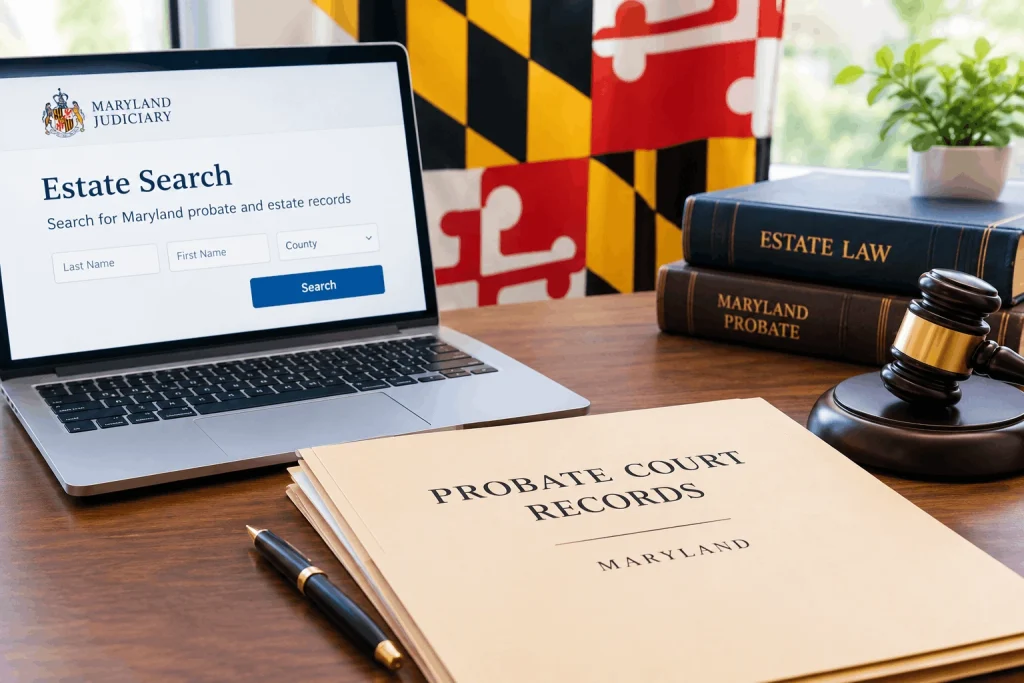
Maryland probate court records can help you determine whether an estate was opened, identify the person responsible for administration, locate a will, review estate activity, and research how a deceased person’s property was handled. The main starting point for modern records is the Maryland Register of Wills’ Estate Search, while older probate material may be held by the Maryland State Archives.
Finding the right record depends heavily on the deceased person’s legal residence, the age of the estate, and the type of information you need. A search for a recent estate is different from a genealogy search for a probate case from the 1800s.
What Are Maryland Probate Court Records?
Probate records document the legal administration of a deceased person’s estate. In Maryland, estate administration is handled through the Register of Wills and, when judicial issues arise, the Orphans’ Court.
What Records Can Be Found?
A probate file may contain several types of documents, depending on the estate and the proceedings involved. These can include:
- Last wills and testamentary documents
- Petitions and applications
- Letters issued to a personal representative
- Inventories of estate assets
- Accounts filed during administration
- Claims against an estate
- Renunciations
- Notices and other estate filings
- Docket entries showing activity in the estate
- Documents associated with judicial proceedings
The contents of an individual file vary. A simple estate may have a relatively limited record, while a contested or complicated estate can contain substantially more documentation.
Probate Records vs. Other Court Records
Probate information should not be confused with Maryland’s general civil and criminal court records. The Maryland Judiciary’s Case Search covers District Court and Circuit Court case information, while Estate Search is specifically designed to provide information from estate records maintained by Maryland Registers of Wills.
That distinction matters because searching the general court system alone may not provide the estate information you need.
Where Are Probate Records Kept in Maryland?
The appropriate record custodian depends on the age and location of the estate.
Register of Wills
Maryland has a Register of Wills office in every county and in Baltimore City. The Register of Wills serves as clerk to the Orphans’ Court and maintains estate records.
For modern estates, the Register of Wills is usually the most useful starting point. Estate Search provides online information about estates filed with Maryland Registers of Wills.
The estate generally belongs in the jurisdiction where the deceased person was domiciled at the time of death. This is important when a person owned property in several Maryland counties. The location of the property does not necessarily determine where the probate estate was opened.
Maryland State Archives
Older probate material may be available through the Maryland State Archives. Its collections include wills, inventories, accounts, petitions, renunciations, estate dockets, and other historical probate documents.
The Archives is particularly important for genealogy and historical research because its probate collections extend back centuries. Availability varies by county, record type, and time period.
How to Search Maryland Probate Court Records Online
For an estate from 1998 forward, Maryland’s Estate Search is generally the first place to check.
Step 1: Identify the Correct Jurisdiction
Start with the county or Baltimore City where the deceased person was domiciled when they died.
Do not automatically choose the county where the person owned a house or other property. If you are uncertain about the jurisdiction, Maryland’s Register of Wills system provides county office information, and contacting the relevant office can help resolve uncertainty.
Step 2: Search the Estate Database
Use the Maryland Estate Search system to search for the deceased person.
Depending on the information available to you, useful search details can include:
- First name
- Last name
- County
- Estate number
- Filing date
- Estate type
- Date range
A last-name search can be useful when the exact spelling of the first name is uncertain.
Step 3: Review the Search Results
Estate Search can provide information such as:
- Decedent’s name
- Estate number
- Estate status
- Date of death
- Date the estate was filed
- Personal representative
- Attorney
- Alias information
- Docket history
This information can help confirm that you have located the correct estate before requesting individual documents.
Step 4: Narrow Broad Searches
A broad search may return too many results. Maryland’s Estate Search limits results to 500 records, so a search producing more than that should be narrowed.
Try combining the surname with:
- A first name
- A county
- A filing date range
- An estate type
- Other identifying information
If you know the estate number, use the complete number where possible.
Understanding Maryland Estate Types
The estate type shown in a search result can provide useful context about how the estate was administered.
Regular Estate
A regular estate is generally used when the assets subject to administration exceed the threshold for a small estate.
The applicable threshold depends on the circumstances, including whether a surviving spouse is the sole legatee or heir. Current Maryland Register of Wills guidance should be checked when determining whether a particular estate qualified as small or regular.
Small Estate
A small estate is used when the assets subject to administration fall within Maryland’s small-estate limits.
The classification can affect the administration process, but it does not mean the estate has no records.
Judicial Estates
Some estates require involvement from the Orphans’ Court because an issue cannot be handled through the ordinary administrative process.
Examples can include disputes concerning the validity of a will or other matters requiring judicial consideration.
Limited Orders
A limited order may be used in circumstances involving the location of estate assets or a will. It is a different type of estate proceeding from a standard full estate administration.
Understanding these abbreviations can make the results in Estate Search much easier to interpret.
How to Find a Will in Maryland Probate Records
A will may be one of the most important documents in an estate file, but finding a will requires understanding its status.
Wills Filed in an Estate
When a person dies with a will and an estate is opened, the will becomes part of the probate record. Members of the public can generally access papers filed in probate estates unless access is restricted under applicable Maryland rules.
Estate Search can help identify the estate. Once you have the correct estate information, you can look for the will and related filings.
Wills Held for Safekeeping
A different situation exists when a living person deposits a will for safekeeping with the Register of Wills. Such a will is not generally a public record while the testator is living.
Therefore, not finding a will through a public probate search does not necessarily mean that no will exists.
Will of No Estate
Maryland also recognizes situations in which a will may be filed even though there are no probate assets requiring estate administration. This is another reason a simple search for a conventional estate should not be treated as proof that no will was filed.
How to Get Copies of Probate Documents
Online estate information and copies of documents are two different things.
Downloading Estate Documents
Maryland’s Register of Wills system provides access to estate documents in PDF format. Copies requested through Estate Search are subject to a per-page charge, so a large estate file can cost more than a short document request.
Before ordering a large file, identify the specific documents you actually need when possible.
Requesting Copies From the Register of Wills
If the document is not available through the online system or you need assistance identifying it, contact the Register of Wills office where the estate was filed.
Have as much information as possible ready, including:
- The deceased person’s full name
- County or Baltimore City
- Estate number
- Approximate date of death
- Approximate filing date
- Specific document requested
This information can make it easier for staff to locate the correct file.
Certified vs. Regular Copies
If you need a probate document for a legal, financial, title, or administrative purpose, determine whether a regular copy or a certified copy is required before ordering it. These are not interchangeable for every purpose.
Ask the receiving agency, attorney, financial institution, or other organization what form of document it requires.
How to Search Older Maryland Probate Records
A modern online estate search is not the best tool for every historical case.
Records From Earlier Periods
Maryland State Archives collections contain probate records from colonial and later periods. Some records have indexes, while others require additional research using archival references.
Historical probate records may include:
- Wills
- Inventories
- Administration accounts
- Estate dockets
- Petitions
- Renunciations
- Other testamentary papers
The organization of these records can differ substantially from modern estate files.
Genealogy Research
Probate records can be valuable when researching family history because they may identify heirs, executors, administrators, guardians, creditors, property, and other relationships.
A researcher should record the county, year, book, page, and series information found in an index before attempting to locate the underlying document.
Old handwriting and historical terminology can also make these records difficult to interpret. The Maryland State Archives provides research assistance and information about its collections.
What If You Cannot Find the Estate?
Not finding a record in an initial search does not necessarily mean that no probate proceeding exists.
Check the County Again
One common mistake is confusing Baltimore City with Baltimore County. They are separate jurisdictions and have separate estate records.
If the deceased lived near a county boundary, verify the person’s actual domicile rather than relying solely on the location of property.
Try Name Variations
Names may appear differently because of:
- Misspellings
- Middle names
- Nicknames
- Alternate spellings
- Married names
- Aliases
- Data-entry differences
Try a simpler search using the surname and jurisdiction.
Check the Date Range
If the death date is known but the estate filing date is not, search a reasonable range rather than assuming the two dates are identical.
An estate may also have been filed later than expected.
Contact the Register of Wills
When an online search fails, the local Register of Wills office is often the best next step. Staff can explain what records are maintained there and whether an older record requires a different search method.
Are Maryland Probate Records Public?
Maryland generally treats papers filed in probate estates as public records, subject to restrictions under applicable Maryland rules.
This does not mean every document connected to a deceased person is automatically public. A document held for safekeeping while the testator is living is treated differently, and other confidentiality rules may apply.
The distinction between public probate filings and protected information is important when researching an estate for legal, family-history, property, or financial purposes.
Probate Records and Property Research
Probate files can be useful when researching inherited property, but they should not be treated as a substitute for land records.
Check Land Records Separately
If your goal is to determine ownership of real estate, review Maryland land records in addition to probate documents.
Probate records may explain who inherited an interest, while a recorded deed or other land document may establish how the property was legally conveyed or recorded.
The Maryland Judiciary provides online access to land-record resources, including MDLandRec. Property ownership and assessment information can also be researched through the Maryland Department of Assessments and Taxation.
Why Both Records Matter
Suppose an estate file identifies a beneficiary who inherited a house. That information may help explain the inheritance, but it does not replace the need to check the relevant deed and land-record history.
Using both record systems gives a more complete picture.
Common Mistakes When Searching Probate Records
Several simple mistakes can make an estate search unnecessarily difficult.
Searching the Wrong Court System
Starting with general civil Case Search instead of Estate Search can lead to incomplete results. Estate records have their own search system.
Assuming Property Location Determines Probate
A deceased person may own real estate outside the county where the estate was opened. Start with domicile, then investigate property separately.
Ordering an Entire File Too Quickly
Large estate files can contain many pages. If you only need the will, letters, or a particular account, identify that document before ordering the complete file.
Ignoring Older Records
Estate Search is especially useful for modern estates, but historical researchers should also consider Maryland State Archives collections.
Treating Online Results as the Complete File
Online search results may provide useful estate information without showing every underlying document. When a specific filing matters, obtain and review the actual document.
Frequently Asked Questions
How do I search Maryland probate records?
Start with the Maryland Register of Wills Estate Search. Search by the deceased person’s name and, when possible, narrow the results by county, estate type, estate number, or filing date.
Are Maryland probate records public?
Papers filed in probate estates are generally public, subject to applicable access restrictions. Wills held for safekeeping for living people are not generally public records.
How far back does Maryland Estate Search go?
Estate Search provides records from 1998 to the present for all Maryland jurisdictions, although some jurisdictions have entered older estate records as well.
Can I find a Maryland will online?
For a will filed as part of a probate estate, you can start by locating the estate through Estate Search and then reviewing the available estate documents. Historical wills may require research through the Maryland State Archives.
What if I cannot find an estate by the person’s name?
Verify the jurisdiction, try alternate name formats, narrow or expand the filing date range, and check the estate number if available. You can also contact the Register of Wills office for the jurisdiction where the estate should have been filed.
Does Maryland Case Search contain probate records?
Estate information is provided through the Register of Wills’ Estate Search rather than relying solely on the Maryland Judiciary’s general Case Search. Case Search is primarily used for other Maryland court case information.
Where can I find old Maryland probate records?
The Maryland State Archives is an important source for historical probate records. Depending on the county and period, records may be indexed, available online, accessible through archival computers, or require assistance from Archives staff.
Final Steps for Finding a Probate Record
The fastest approach is to match the search method to the age and purpose of the record.
For a recent estate, begin with the Maryland Register of Wills Estate Search. Confirm the jurisdiction, review the estate number and docket information, and then request the specific documents you need.
For older family-history research, expand the search to the Maryland State Archives and pay attention to archival series, book references, dates, and county records.
If the estate involves real property, review land records separately. And if the record is being used for a legal transaction, verify whether a certified copy or another specific document is required before placing an order.
A careful search across the appropriate Maryland record systems can provide much more than the fact that an estate existed. It can help establish the history of an estate, identify relevant filings, locate wills and administrative documents, and point researchers toward the records needed for deeper legal or family-history research.