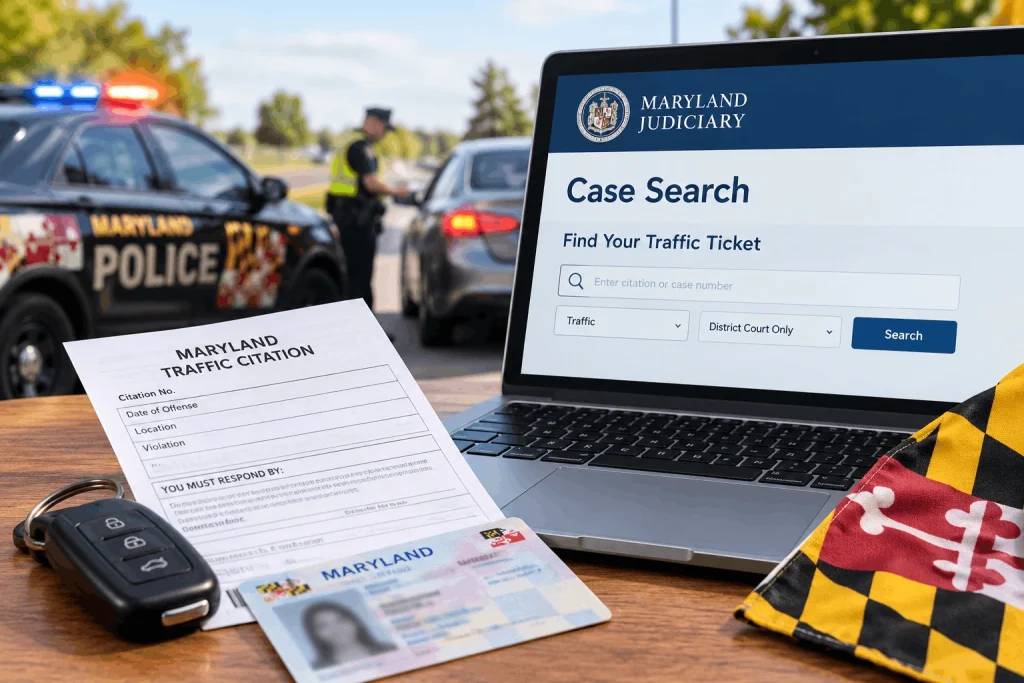
A Maryland traffic ticket can be difficult to track when you have misplaced the citation, do not remember the court date, or simply want to confirm whether a case has been filed. The Maryland Judiciary provides an online Case Search system that can be used to find public traffic case information. The search can help you identify a citation number, case number, violation date, charge, court information, hearing details, and case status.
The important distinction is that a traffic court record is not the same as a Maryland driving record. The court handles the citation and its legal disposition, while the Maryland Motor Vehicle Administration (MVA) maintains information about your license, convictions reported to the agency, points, suspensions, and other driving-history matters.
Knowing which record you need can save time and prevent you from using the wrong search system.
How Maryland Traffic Ticket Search Works
Maryland traffic citations that become District Court cases can generally be located through the Maryland Judiciary’s Case Search. The system provides public access to selected information from Maryland court records.
A traffic ticket search is useful when you need to:
- Find a lost or misplaced citation
- Confirm the citation or case number
- Check the charge listed by the court
- Review a scheduled hearing or trial date
- Find the court handling the case
- Check the disposition of a traffic case
- Review publicly available fine or case information
- Determine what happened after responding to a citation
Case Search is a summary of the court record, not a replacement for the complete case file. If you need a certified document or information that is not displayed online, you may need to contact the appropriate District Court clerk.
Search a Maryland Traffic Ticket Online
The Maryland Judiciary Case Search is the primary online starting point for a Maryland traffic ticket search.
Search by Citation Number
If you still have your ticket, the citation number is usually the most useful information to have. Maryland Courts instruct users to enter the citation number in the case-number search field.
To search:
- Open the Maryland Judiciary Case Search website.
- Accept the site’s terms and conditions.
- Choose the option to search by case number.
- Enter the citation number.
- Select Traffic as the case type.
- Select District Court Only as the court system.
- Submit the search.
- Open the matching case to review the available information.
Using the citation number can reduce confusion when several people have similar names.
Search by Name
You can also search when you no longer have the citation number.
Use the name as it appears on your driver’s license or court paperwork. Maryland Case Search uses exact-name searching by default. The system also provides a method for partial-name searches using the required wildcard format.
Name searches can be less precise than citation-number searches, particularly when the name is common. Check the case details carefully before assuming a result belongs to you.
Compare details such as:
- Full name
- Case number
- Violation date
- Court
- Charge
- Case type
- Hearing information
Do not rely on a name match alone.
What Information Can You Find?
A Maryland traffic case search can provide useful information about the court case created from a citation.
Depending on the case and information available to the public, you may find:
| Information | What It Tells You |
|---|---|
| Case number | Identifies the court case |
| Citation number | Identifies the original traffic citation |
| Defendant name | Identifies the person associated with the case |
| Charge | Describes the alleged traffic violation |
| Violation date | Shows when the alleged violation occurred |
| Court | Identifies the court handling the matter |
| Hearing or trial date | Shows a scheduled court event |
| Disposition | Shows how the court case was resolved |
| Fine or costs | Shows financial obligations recorded in the case |
| Case events | Shows relevant actions recorded on the docket |
The exact information displayed can vary by case.
A record appearing in Case Search should also be read carefully. A charge is an allegation until the case is resolved. The existence of a traffic case does not, by itself, establish that the driver was convicted.
Traffic Ticket vs. Driving Record
One of the most common sources of confusion is treating a court case and a driving record as the same thing.
They are maintained for different purposes.
Maryland Court Record
The Maryland Judiciary record is primarily about the legal case. It can show information such as:
- Citation and case identifiers
- Traffic charges
- Court dates
- Pleas or requests
- Court decisions
- Fines and costs
- Other docket events
Maryland MVA Driving Record
The MVA driving record focuses on your driving history and license status. It can include:
- Moving violations
- Convictions reported to MVA
- Driver’s license points
- Suspensions
- Revocations
- License status
- Other driving-history information
If your question is “What happened to my ticket?”, start with the court record.
If your question is “How many points are on my license?”, check your MVA driving record.
This distinction is particularly important after a ticket has been resolved. A court case may be closed while a separate MVA record continues to show a conviction, points, or license action.
Does Receiving a Ticket Automatically Add Points?
No. Receiving a traffic citation does not automatically place points on your Maryland driving record.
The MVA states that points are added after a conviction is recorded and reported to the agency. The number of points depends on the particular violation.
For example, Maryland’s point system covers violations such as:
- Speeding
- Failure to obey traffic signals
- Reckless or aggressive driving
- Improper passing
The MVA tracks points over a two-year period when determining certain administrative actions.
A useful distinction is therefore:
Citation → Court case → Disposition or conviction → MVA record
The precise consequences depend on the violation and how the case is resolved.
What Happens After You Find Your Ticket?
Finding the ticket is only the first step. You should next determine what type of citation you received and what response is required.
Payable Traffic Citations
A payable citation generally gives the driver the option to pay the specified fine rather than appearing for a standard trial.
Maryland Courts currently state that payable citations require a response within 30 days after receipt. Depending on the circumstances, available choices can include paying the fine, requesting a payment plan if eligible, requesting a waiver hearing, or requesting a trial.
Read the citation carefully before making a decision.
Paying a payable traffic citation is not simply an administrative payment. Maryland Courts explain that paying the fine constitutes a guilty plea, and the resulting conviction may be reported to MVA for points.
Requesting a Trial
If you want to contest the citation and plead not guilty, follow the trial-request instructions on the citation.
Do not pay the fine first if you intend to request a trial. Payment is a guilty disposition for the payable charge.
A trial is different from a waiver hearing. At a trial, you contest the charge. A waiver hearing is generally associated with pleading guilty with an explanation and asking the judge to consider the circumstances when determining the outcome or penalty.
Payment Plans
Maryland Courts provide a payment-plan option for qualifying traffic obligations. Current court guidance states that a person generally needs at least $150 in total outstanding fines and must otherwise qualify.
Do not assume that every ticket automatically qualifies. Review the current court instructions and the requirements that apply to your case.
What If You Lost Your Maryland Traffic Ticket?
Losing a ticket does not mean you should ignore it.
Maryland Courts provide a Lost or Missing Traffic Citation Option Form for certain Maryland Uniform Complaint and Citation forms. The court instructs people who have misplaced a citation to retrieve the necessary citation information through Case Search and use the appropriate option form.
The information you may need includes:
- Citation number
- County where the citation was written
- Violation information
- Fine amount, if applicable
- Your identifying information
- The response you want to make
The form can be used to select an available response such as paying the fine, requesting a payment plan, requesting a waiver hearing, or requesting a trial.
Most importantly, do not let a missing piece of paper cause you to miss the response deadline.
What If the Ticket Does Not Appear?
A citation may not immediately appear in an online case search.
If you cannot find it, consider the following:
Check the Citation Number
A single incorrect digit can produce no result or an unrelated result. Re-enter the number exactly as shown on the ticket.
Try Your Name
If the citation number does not work, search using your legal name. Make sure the spelling matches your citation or driver’s license information.
Allow for Filing Time
A citation issued recently may not yet be visible in the court’s online system. Online case information depends on the case being entered into the Judiciary’s system.
Contact the Court
If the deadline is approaching and you still cannot locate the ticket, contact the appropriate District Court rather than assuming there is no case.
This is especially important when you have received a citation requiring action within a specified period.
How Long Do Traffic Cases Stay Online?
Not every traffic case remains visible in the same way indefinitely.
The Maryland Judiciary explains that certain closed District Court traffic cases involving minor infractions and without serious consequences are moved to a history database after the case has been closed for 36 months. Those records may no longer appear in the normal public Case Search results.
Serious traffic matters can be treated differently and may remain available.
This means an old ticket that no longer appears in a normal search does not necessarily mean the court has no record of it. If you need an older case, contacting the appropriate clerk may be necessary.
What If You Missed the Deadline?
Ignoring a Maryland traffic citation can create additional problems.
Maryland Courts state that failing to respond to a payable citation within the required 30-day period can result in notification to the MVA, which may take action affecting your driving privileges.
A failure to appear for a scheduled trial can also lead to additional consequences, including action involving the driver’s license.
If you discover that you missed a deadline:
- Search Case Search for the current case status.
- Check for a hearing, failure-to-appear entry, or other case event.
- Contact the appropriate District Court clerk.
- Ask what action is required to resolve the matter.
- Check your MVA record if you are concerned about a suspension or other license action.
Do not continue driving if you have reason to believe your driving privilege has been suspended. Verify your status with MVA.
How to Check Maryland Traffic Points
Case Search is not the best tool for checking your current point total.
The Maryland MVA maintains driving records and allows drivers to obtain driving-history information. A driving record can show convictions, moving violations, points, suspensions, revocations, and other information depending on the record type.
The MVA provides both certified and non-certified driving records.
A non-certified record can be useful for personal review, while a certified record may be required for certain official purposes.
If you are trying to determine whether a recent ticket affected your license, checking both records can provide a clearer picture:
Court Case Search: What happened in the traffic case?
MVA Driving Record: What was reported to your driving history?
Are Camera Tickets the Same?
Not every traffic-related notice follows the same process as a traditional officer-issued traffic citation.
Maryland courts maintain separate information and procedures for automated traffic monitoring programs, including certain speed, red-light, school-bus, and other monitoring citations.
This is important because a camera notice may not behave exactly like a standard District Court traffic case in an online search.
If you received an automated enforcement notice, read the issuing agency’s instructions on the notice. Use the payment, dispute, or hearing method specified there rather than assuming the citation can be handled through the same process as every ordinary traffic ticket.
Common Maryland Traffic Search Mistakes
A few mistakes can cause unnecessary delays or missed deadlines.
Searching Only by Name
A common name can produce multiple results. Use the citation number whenever possible.
Assuming No Search Result Means No Ticket
A recently issued citation may not yet appear online. An older case may also have moved to a history database.
Confusing Court Records With MVA Records
The court record and driving record serve different purposes. Use the correct agency for the information you need.
Paying Before Deciding to Contest
For a payable citation, payment represents a guilty disposition. If you intend to contest the charge, review your options before paying.
Ignoring a Lost Citation
A missing ticket is not a reason to wait. Case Search and the court’s lost-citation procedures can help you recover the information needed to respond.
Frequently Asked Questions
Can I search a Maryland traffic ticket by name?
Yes. Maryland Judiciary Case Search allows traffic cases to be searched by party name. Exact-name searching is the default, so enter the name carefully and verify the case details before treating a result as your own.
Can I search a Maryland traffic ticket by citation number?
Yes. Maryland Courts specifically direct users to enter the citation number in the case-number search field and select Traffic and District Court Only.
How quickly does a Maryland traffic ticket appear online?
There is not a single guaranteed posting time for every citation. A recently issued ticket may not immediately appear in Case Search because the case must first be entered into the court system.
Can I find a lost Maryland traffic ticket online?
Often, yes. Case Search can provide citation and case information needed to identify a lost citation. Maryland Courts also provide a lost or missing citation option form for applicable tickets.
Does paying a Maryland ticket add points?
Paying a payable traffic citation is a guilty disposition. If the resulting conviction is reported to MVA, points may be added according to the violation.
How can I check whether my license is suspended?
The MVA maintains Maryland motor vehicle records and information about outstanding suspensions. If you are concerned about your license status, verify it directly with MVA rather than relying only on a court-case search.
Can I use Case Search as my official driving record?
No. Case Search provides court-case information and is not the same as an MVA driving record. For points, license status, suspensions, and driving history, obtain the appropriate MVA record.
What should I do if my ticket is not in Case Search?
Check the citation number again, try a name search, and consider whether the ticket was issued recently. If you still cannot find it and a response deadline is approaching, contact the appropriate District Court.
Final Takeaway
A Maryland traffic ticket search is usually best started through the Maryland Judiciary Case Search when you need information about a court citation. The citation number provides the most direct route, while a name search can help when the ticket has been lost.
After finding the case, pay attention to the charge, response deadline, court date, and available options. Do not confuse a court case with your MVA driving record, especially when points, suspensions, or license status are involved.
For a payable citation, Maryland generally requires action within 30 days. Paying the fine can result in a guilty disposition and may lead to points after the conviction is reported to MVA. If you intend to contest the ticket, review the trial or waiver-hearing procedures before making a payment.
When online information is incomplete, outdated, or unavailable, the appropriate District Court clerk remains an important source for case-specific assistance and official court records.